
Avian influenza in North America is concerning epidemiologists: three people have been infected with the H5N1 virus without any source of contamination being identified
Written by Giuseppe Caprotti
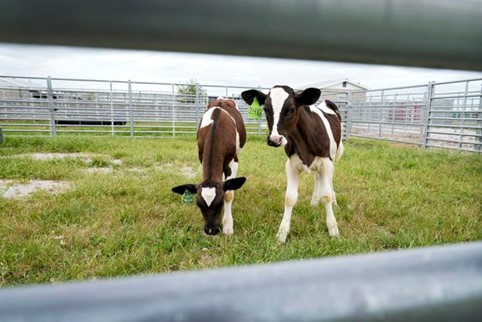
Calves at the National Animal Disease Center, U.S. Department of Agriculture, Ames, Iowa, August 6, 2024.
CHARLIE NEIBERGALL / AP but in this article we discuss a virus that is also present in Italy, although swine fever is more widely known.
Drafted on December 7, 2024, updated on January 25, 2025
A teenager in Canada and a child in California have fallen ill without a known cause, following an initial case in Missouri. Epidemiologists fear that the limited circulation of the virus is triggering an epizootic among dairy cows in the United States. This may not seem like much compared to the 53 cases reported among agricultural workers in dairy and poultry farms – settings that have become the stage for an epizootic (an animal epidemic) that is spreading day by day across the United States.
By Delphine Roucaute
However, these three atypical cases increasingly remind specialists of the early days of the H1N1 influenza epidemic in 2009. At that time, two sporadic cases of swine flu in California children with no known contact with pigs or with each other were the first warning signs of a pandemic that eventually caused 280,000 deaths worldwide.
“During epidemics, it is crucial to understand where and how transmission occurs,” explains British epidemiologist Adam Kucharski. “If we do not know the source of infections, we cannot be sure of the threat we face, nor can we determine whether the situation is under control.”
A first case without a known source was identified on September 6 in the state of Missouri. An epidemiological investigation, concluded at the end of October, eventually determined that likely not one but two people from the same family contracted the H5N1 virus simultaneously. Yet, we still do not know where or how.
New Mutations
On November 13, a second concerning signal emerged from Canada, where an adolescent in British Columbia became severely ill. Samples taken from his immediate environment did not reveal the presence of the H5N1 virus, and it appears that the patient did not transmit the infection to anyone else. In the absence of new evidence, provincial authorities closed the epidemiological investigation. As of November 26, the patient remained hospitalized and on a ventilator. This marks the first very severe case of avian influenza this year, with other cases presenting primarily as conjunctivitis or mild flu-like symptoms.
This case is especially alarming because it appears the virus has acquired additional mutations. Scott Hensley, a microbiology professor at the Perelman School of Medicine at the University of Pennsylvania, analyzed the sequence data released in open-access databases by the Public Health Agency of Canada. He reported via social media that two key mutations had appeared in the hemagglutinin protein – a surface protein that the virus uses to attach to the cells it invades. These mutations are known to help the virus bind more effectively to human lung cells, marking an important change for a virus that typically binds more readily to avian cells.
Moreover, unlike the American cases, the virus that infected the Canadian patient is similar to that currently circulating among wild birds, rather than the strain spreading among dairy cows in the United States. “It is likely that we are witnessing overlapping outbreaks,” notes Adam Kucharski. In addition to the human cases, reports of infections in pigs are particularly concerning, as these animals have historically served as a mixing vessel for viral strains during previous pandemics. For example, the detection of the virus in a pig in Oregon at the end of October prompted a rapid investigation that resulted in the animal being culled.
Milk Recalls
The latest case involved a child in California who tested positive for H5N1 avian influenza on November 19 and exhibited only mild symptoms. Authorities reported that none of his family members tested positive for the virus, although they did display similar symptoms. This episode occurs against a backdrop of a severe epizootic among California’s dairy herds – with as many as 474 herds affected by the virus since the outbreak began in the Golden State, the leading milk-producing state in the United States.
Within one week, two bottles of raw milk sold in California stores tested positive for the H5N1 virus, prompting Raw Farm, based in Fresno, to recall its potentially contaminated batches. Although raw milk consumption is relatively rare in the United States, the practice is currently trending—especially on TikTok. Robert F. Kennedy Jr., who is poised to become the future Health Minister (the equivalent of the current U.S. Secretary of Health) and has actively promoted raw milk for years, is among its proponents.
All these factors have led Maria Van Kerkhove, the American epidemiologist heading the Prevention and Preparedness for Epidemics and Pandemics Department at the World Health Organization, to call on the international community to strengthen surveillance against avian influenza. In a press conference on November 28, she stressed, “We have not observed signs of human-to-human transmission,” but added, “For every human case detected, we want a very thorough investigation… so that we are prepared for the possibility of an influenza pandemic.” “We are not there yet, but we must remain extremely vigilant,” she insisted.
Wastewater monitoring, in particular, could be an important tool for identifying sources of contamination. Samuel Scarpino, Director of the Department of Artificial Intelligence and Life Sciences at Northeastern University, reported that very high levels of H5 influenza were measured at investigation sites near dairy farms, suggesting that residues from milk production may be released into the sewage system—although at this point it is unclear whether the circulation of contaminated milk in wastewater poses a risk. Even more concerning, nearby wastewater treatment plants in more urbanized areas have shown an increase in influenza activity and positive samples for the H5 virus. These are only preliminary signs that U.S. health authorities would do well to exploit, especially as the onset of winter and the rise in “regular” flu cases could obscure these faint traces.
Fortunately, in Italy a bipartisan law will soon mandate the labeling of raw milk. This initiative by two parliamentarians – FdI deputy Matteo Rosso and Democratic senator Lorenzo Basso – follows the case of a child in Arenzano who died after consuming cheese made from raw milk contaminated with Escherichia coli.
It is also worth noting that, as Ilaria Capua has been saying since the COVID-19 days, the indiscriminate exploitation of nature and animals leads to disease (read more about Pandemics and Biodiversity).
And now, rightly, she adds, “sooner or later, avian influenza will make its mark on us.” This is precisely what is happening in the United States: the first severe case of avian influenza in a human has been detected, and not only that—the first human death due to the H5N1 strain circulating in dairy farms has occurred.
It should also be noted that the virus continues to circulate among wild birds in Europe, particularly along migratory corridors. To break this cycle, the French government has made vaccination mandatory in flocks of over 250 ducks.
In Italy, we will have to consider a new model for the evolution and development of poultry farming—one that is equally professional but better distributed and less concentrated (recent outbreaks were all clustered between Mantua and Verona, and the only way to halt the virus’s spread was).