Guido Venosta – University studies: Cambridge and Pavia
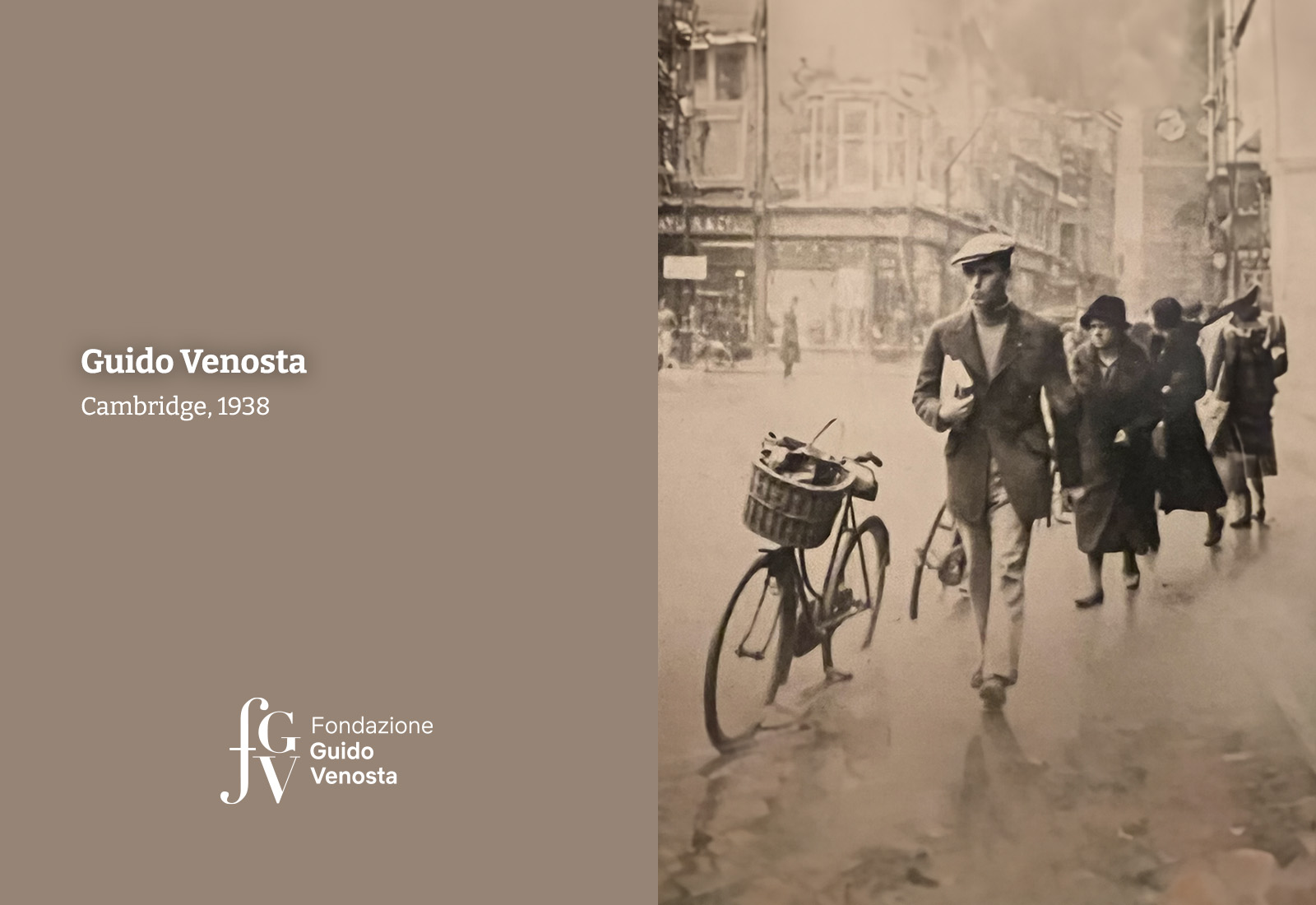
“After completing military service and brilliantly passing the state exam for university admission, I still did not feel ready to choose a specific path for my future. I timidly suggested pursuing a law degree and then embarking on a career in one of the legal fields, but my father opined that such a choice might not ultimately provide me with all the satisfactions to which I was entitled to aspire.
It was then that a suggestion from Alberto Pirelli, conveyed to my father, clarified and opened a door I had never even considered: between Bocconi and Cambridge, Alberto Pirelli emphatically recommended Cambridge, where I could study the economics of the modern world in broad terms and in an environment particularly conducive to comprehensive and well-rounded instruction. Indeed, the Cambridge School of Economics enjoyed—and still enjoys—a lively international reputation, with faculty of exceptional caliber.
Through a friend, we contacted Professor [Angelo] Sraffa, who taught commercial law at Bocconi University. His son, Piero Sraffa, who later became very famous, was already teaching at Trinity College (…). [Angelo was a distinguished jurist and economist, one of the founders of modern Italian commercial law; Piero became one of the greatest economists of the twentieth century and was also an important figure in philosophical and political culture—see the entries dedicated to them in the Treccani Encyclopedia, editor’s note]. (…)
In truth, everything was simple in this world clad in flannel trousers and tweed jackets. I spent one year in the rooms of St. John’s College and two years in the “Digs,” the college-controlled off-campus accommodations. (…). The teaching at Cambridge was very pragmatic. It was a surprise to me, having already begun to learn the rhetoric of the Italian university system. (…)
I had top-notch professors, among whom was John M. Keynes, who at that time was actively helping to stabilize Europe’s economic and financial situation following the turmoil after World War I (…). I also had instructors such as Joan Robinson [who contributed to the promotion and dissemination of Keynes’s work and was the first woman to be named an “honorary fellow” at King’s College, editor’s note], Arthur C. Pigou—who, along with Sir William Beveridge, was one of the founders of the Welfare State; Sir William Robertson [one of the great experts in monetary economics, editor’s note]; Maurice Dobb [a Marxist and historical economist, author of notable works essentially dedicated to planning and development issues, editor’s note] (…).
I returned from Cambridge enriched with a wealth of knowledge and with many aspects of my character distinctly improved. (…) I left with a “Second First, Economics”—a truly honorable score for a Latin scholar.
Guido Venosta, who remained a “Johnian” for life thanks to his degree, was regularly invited to the grand gala dinner that, on alternate years, brings together the “Master of Arts” in the great hall of the College. Unfortunately, in his later years, he was no longer able to attend.
“Returning to Italy with such a brilliant result packed in my suitcase, my father asked what I desired as a reward. I replied that a vacation lasting a few months in Austria would be very welcome: another language, winter sports—Alpine sports—and an international environment. I became part of the family of an Austrian lawyer who, in his early career, had been a magistrate in Ala [in the province of Trento, editor’s note] (then Austrian territory), so he knew Italian very well (…). The city had become an international hub for winter sports (…).
Beyond social encounters with celebrities of every kind and nationality, one could still feel in the air the rich culture of old Austria and that of Central Europe. (…) Everything I had learned before—and later at Cambridge—was completed by my stay in Austria, which made me more serene, more tolerant, and more even-minded towards both people and things. My parents visited me in Innsbruck and took me to Salzburg. We attended a memorable performance of ‘Fidelio’ conducted by Arturo Toscanini. (…)”
Curiously, in my “Memoirs” I make no mention of the law degree I obtained at the University of Pavia, where I also studied under Giuseppe Ugo Papi, who at that time taught statistics and public finance and would himself become a great economist. According to my university record, I enrolled in that faculty in 1929 at the Regia Università di Milano, and perhaps it was there that I first “began to learn the rhetoric of the Italian university.” It is unclear how I managed my studies, as it appears they were pursued concurrently with those at Cambridge, given that each academic year the record bore its respectable stamp. The fact remains that, after transferring from the Milanese institution to the University of Pavia (academic year 1934-1935), I graduated in 1936 with a thesis on “Facts of English and American Monetary Policy with References to the Policy of the Bank of England and the Federal Reserve Board.” One can only imagine that even at Pavia it was rare at the time to see a Cambridge student—already a “Bachelor of Arts” (i.e., a first-level graduate)—writing a 169-page thesis with more books cited in English than in Italian. And the following year, in January 1937, I would have proudly obtained the “Master of Arts” from the English university, making me a specialist graduate in Economics at the highest level.”
Sources:
Albiate, Villa San Valerio Archives, Guido Venosta Archive, G. VENOSTA, “Unpublished Memoirs (1996-97)”, pp. 25/1–27.
Ibid., “Diplomas and Certificates”, photocopies of the original Cambridge University diplomas, dated respectively June 19, 1934, and January 23, 1937.
Ibid., “Personal Documents”, Guido Venosta’s academic transcript, enrolled on October 21, 1929, at the Regia Università di Milano, Faculty of Law; Ibid., thesis, a typed and bound copy.
Bibliography:
MONTI, A., SRAFFA, Angiolo Gabriele (Angelo), entry in “Dizionario Biografico degli Italiani – Volume 93 (2018)” (https://www.treccani.it/enciclopedia/angiolo-gabriele-sraffa_(Dizionario-Biografico)/?search=SRAFFA%2C%20Angiolo%20Gabriele%2F).
DE VIVO, G., NALDI, N., SRAFFA, Piero, entry in “Dizionario Biografico degli Italiani – Volume 93 (2018)” (https://www.treccani.it/enciclopedia/piero-sraffa_(Dizionario-Biografico)/).
KEYNES, John Maynard, entry in “Treccani. Enciclopedia on line” (https://www.treccani.it/enciclopedia/john-maynard-keynes/).
ROBINSON, Joan Violet, entry in “Treccani. Enciclopedia on line” (https://www.treccani.it/enciclopedia/joan-violet-robinson/?search=Robinson%2C%20Joan%20Violet%2F).
PIGOU, Arthur Cecil, entry in “Treccani. Dizionario di Economia e Finanza (2012)” (https://www.treccani.it/enciclopedia/arthur-cecil-pigou_(Dizionario-di-Economia-e-Finanza)/).
TREVES, P., BEVERIDGE, Sir William Henry, entry in “Treccani. Enciclopedia Italiana – II Appendice (1948)” (https://www.treccani.it/enciclopedia/beveridge-sir-william-henry-primo-barone_(Enciclopedia-Italiana)/).
ROBERTSON, Sir Dennis Holme, entry in “Enciclopedia online” (https://www.treccani.it/enciclopedia/sir-dennis-holme-robertson/).
DOBB, Maurice Herbert, entry in “Enciclopedia Italiana – III Appendice (1961)” (https://www.treccani.it/enciclopedia/maurice-dobb_(Enciclopedia-Italiana)/).
GIOLI, G., “PAPI, Giuseppe Ugo”, entry in “Dizionario Biografico degli Italiani” – Volume 81 (2014) (https://www.treccani.it/enciclopedia/giuseppe-ugo-papi_(Dizionario-Biografico)/).