
Guido Venosta – The war, the brothers, the mother, the house in Gornate Olona
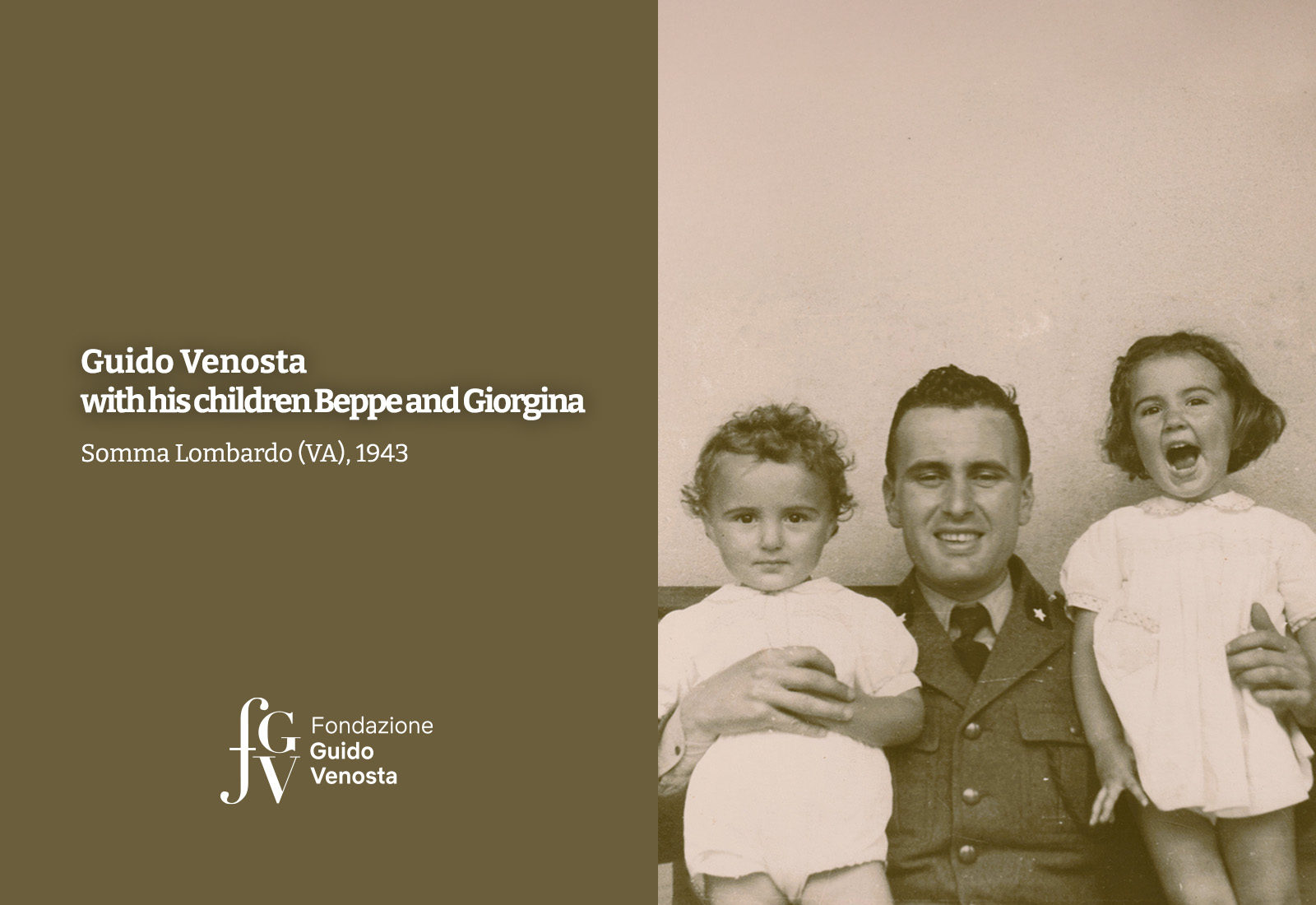
“… Yet once again fate confronted us with events we neither expected nor ever wished to imagine.
Within a span of just ten years, both my father and mother left us, victims of that then-considered invincible disease—cancer. I suddenly found myself forced to become the head of the family.
I immediately felt the responsibility to inform the Pirelli brothers of the great loss the company would soon have to endure; a certain affectionate gratitude had long bound the two brothers to their general director.
I tried every possible avenue, but, as I mentioned, no one at that time knew how to face cancer. My father was attended by two professors who, in my opinion, knew as little about the disease as I did. The illness had been diagnosed a few months earlier by our family doctor as nervous exhaustion. I sought the expertise of [Mario] Donati, the greatest Italian surgeon then alive. Donati gently ruled out any possibility of intervention—at least with regard to my father. At that time, the liver was considered inoperable. (…)
Nevertheless, my father died in excruciating pain, reduced to a mere shadow of himself yet always valiantly present as if to show us that he was not afraid, but trusted in us. (…)
That morning, after a visit from Father Zucca [Enrico Zucca, a Franciscan friar who maintained close ties with the most influential and affluent families of Milan’s aristocracy and business circles—and who, in ’46, would gain some notoriety for having helped conceal Mussolini’s body, editor’s note] at the urging of Tommaso Gallarati Scotti, I found myself in the small garden of the building [the Columbus Clinic in via Buonarroti, Milan, editor’s note] with my friend Lele Pesenti when Colonel Bettoni—who had been my superior in Savoia [the Savoia Cavalleria Regiment, where Guido had served, editor’s note]—rode by on horseback, accompanied by his attendant. Bettoni stopped and, upon hearing the news, was visibly shocked. Meanwhile, his horse, with its long, graceful neck, quietly nibbled at the hedge that separated us.
This remains, for me, the final memory of that unspeakable tragedy.
In a room nearby lay the lifeless simulacrum of the person I had loved most. A final farewell forever to pleasant conversations, to an unparalleled example of tolerance and generosity—always with the respect due to a man regarded not as an adversary, but as someone to be respected, taught, and assisted.
I believed that everything was over, yet the years that followed taught me that one can continue to love a departed soul with the same passion as when they were alive. And so I did, and everything seemed to go on as before. (…)
As was customary at the time, the solemn funeral of Giuseppe Venosta—complete with a brass band—was immortalized in a photographic album. We have images of the departure of the funeral hearse, preceded and followed by an exceedingly long cortege that, starting from the “Columbus” clinic, wound its way along the entire route leading to the church of San Pietro in Sala, in Piazza Wagner, where the funeral rites were celebrated. Behind the casket were the family members: the widow, Argia, and the three children—Guido, at the center in civilian clothes, and Luigi and Giorgio, both in military uniform; immediately behind Guido, prominently featured, was Luisa Quintavalle, who soon became his fiancée and wife. Pirelli sent a substantial delegation which, parading behind its banner and serving as an honor guard in the church during the rites, offered a fitting final salute.
In war, Guido’s two brothers also went: Luigi, known as Gigi—a professional player and national ice hockey athlete in the 1920s—and Giorgio, who became the godfather of Guido’s eldest daughter, Giorgina.
“My brother Giorgio, after spending time in Yugoslavia, was assigned with his entire regiment to the Russian front, accompanying the Terzo Bersaglieri. (…) I went to Lazise to see my brother off. Giorgio completed the entire retreat from Russia; I believe that someone looked after him from above.
My pilot brother [Luigi] fought as the crew chief of an S73 bomber. After an action over Alexandria, Egypt, and against the English fleet at La Fonda, his squadron was attacked on the return journey by a formation of Spitfires. One of them, in particular, targeted my brother’s aircraft. (…) The combat was extremely fierce. (…) The second pilot fell. The tail gunner, clinging to his machine gun, fell. To his right, my brother saw two S73 aircraft in flames. From one of them, Milo Mussi—who had been a fine ice hockey player and was one of our own [Camillo “Milo” Mussi was a hockey player and companion of Luigi Venosta, editor’s note]—parachuted into the sea. We never saw him again, and our parents searched for years, hoping he might have survived. A fortunate twist allowed my brother to evade pursuit. He managed to bring his aircraft back to Italian territory, albeit with casualties and injuries; he earned a silver medal on the field. This episode was recounted in full detail on the English radio the very evening of the clash. (…)”
At this point, my grandfather’s memoirs become somewhat confused, having largely remained as scattered notes. What can be pieced together is that the house on via Vivaio, where the Venosta family had lived for many years, was set on fire during the Allied bombings after September 8, and only the timely intervention of a friend who managed to summon the fire brigade limited the damage, allowing for its post-war reconstruction. Fortuitously, my grandfather, having returned from Cervinia to tend to my mother and the family affairs, managed to reach Liberation alongside his brothers, who had returned from the front. And so, life began anew for all.”
Sources:
Albiate, Villa San Valerio Archives, Guido Venosta Archive, G. VENOSTA, Unpublished Memoirs (1996-97), pp. 27–34.