
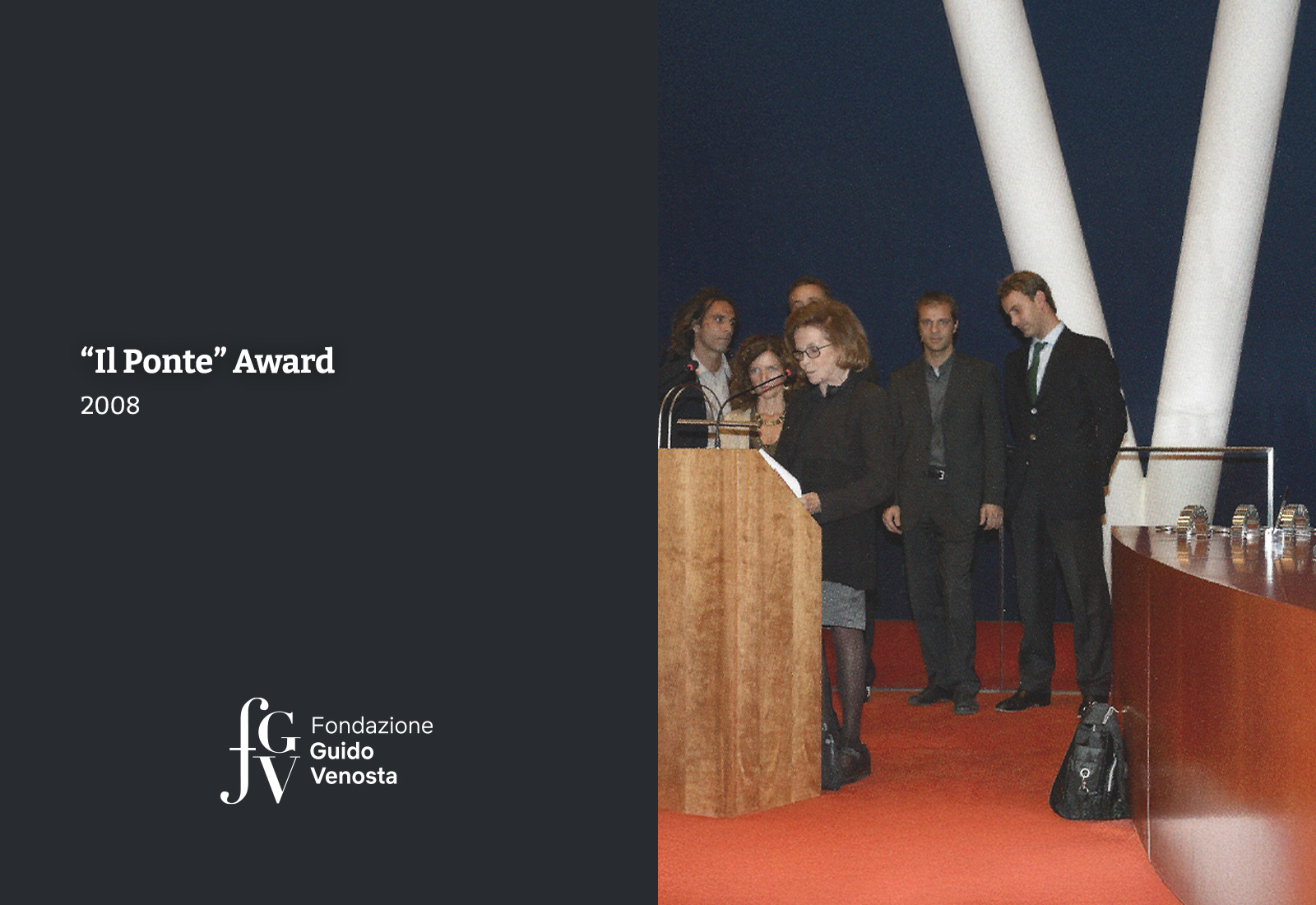
The “Il Ponte” Award Splits: One for Nonprofit and One for Design (2008)
In 1982, as Vice President of ICSID (International Council of Societies of Industrial Design) and a member of the ADI (Italian Association for Industrial Design) committee, I was invited to Ahmedabad [the most important city in the Indian state of Gujarat, Ed.] to the National Institute of Design (NID). I was deeply struck by the civic and social significance of what is now known as the ‘Ahmedabad Declaration.’
The document, originally promoted by NID in agreement with UNIDO (United Nations Industrial Development Organization) and ICSID, was actually drafted by Pandit Nehru—who was then India’s Prime Minister—along with architects Charles and Ray Eames. Essentially, it was a declaration committing designers ‘to seek local responses to local needs by rediscovering the resources and traditions of each community and reinterpreting them through the power of new technologies.’ In other words, it laid the ideological foundations for design for development—an approach to design that is ethically and authentically social. (…).
Today, in 2008, on the occasion of its fourth edition, the Il Ponte Award has expanded its thematic horizons and ventured into the realm of design.
What connects these themes? In fact, since its inception, design has played an important role within the Foundation. Clear evidence of this can be seen in the innovative graphics of its newsletters, the careful design of every communication effort, the very objects that embody its awards (the Ponte sculpture and the Medals), and the overall design of its coordinated visual identity.
Two events in the second half of 2007 further reinforced this design presence, transforming it into a more autonomous expressive need. The first was the publication of the anthology Carla Venosta: Thirty Industrial Design Projects in Italy, a book that recounts my professional journey in applied industrial arts. The second was the much-anticipated inauguration of the Triennale Design Museum, where three of my works—including the steel Il Ponte sculpture—became part of the permanent collection.
These events reminded me of the core principles of my work, as design has never been just a profession for me—it has always been, above all, a quest for both formal and substantive innovation, deeply rooted in the ethics of civic engagement. Thus, we arrive at a concept of design as a discipline of project development aimed at improving what exists—whether by optimizing the relationship between productivity and energy consumption, enhancing the functional and aesthetic unity of a product, increasing its everyday utility, or simply fostering the fundamental well-being that comes from living in contact with beauty.
With these premises, this year’s award has taken on a dual focus. The Foundation has now established two distinct recognitions: an Il Ponte Award for nonprofit initiatives and an Il Ponte Award for design. While they may represent different ideal architectures, the fundamental bridges they seek to connect remain the same.
The award evolves, its scope expands, and within this ‘new frontier,’ two vital forces—long moving in the same direction—have come together: on one side, the traditional shift from profit to nonprofit (economic and social solidarity); on the other, design for development (development as an ultimate goal). (…).
In conclusion, I would like to return to the manifesto of the Ahmedabad design for development initiative, linking it to a reflection on form—one that must evolve into the ‘form of ethics,’ just as ethics itself must evolve into an ‘ethics of responsibility’ (Max Weber’s Verantwortungsethik, 1916). This is a call to assess the consequences of our choices (…), an ethics that never loses sight of the ultimate outcomes of our actions, but rather adopts them as a guiding principle. Such an approach should serve as a fundamental point of reference for the worlds of industry, politics, economics, and society in all its expressions. (…).”
Sources:
C. VENOSTA, Ethics of Responsibility: A Journey, Albiate (MB), Villa San Valerio, Archives of Villa San Valerio, Archive of the European Foundation Guido Venosta, FGV Newsletter 2009 (printed edition).