
Giuseppe Caprotti’s Social Commitment at Esselunga: People – the Customers
The customer is the foundation, the pillar of the company — the one who buys the product and, if satisfied, returns with pleasure. From the very beginning, both the Americans and my father set a clear direction: a strong focus on the quality and affordability of Esselunga’s products.
However, my father’s method — and that of his close team — could be summed up as: “I decide what you buy.” That’s not how I see it.
When I joined Esselunga, I began to progressively change the marketing approach, through years of careful and patient work. I shifted it “from I to we”: from decisions made and imposed by a single leader to a process of sharing ideas and projects with collaborators, with the goal of selecting products and services that genuinely appeal to our customers.
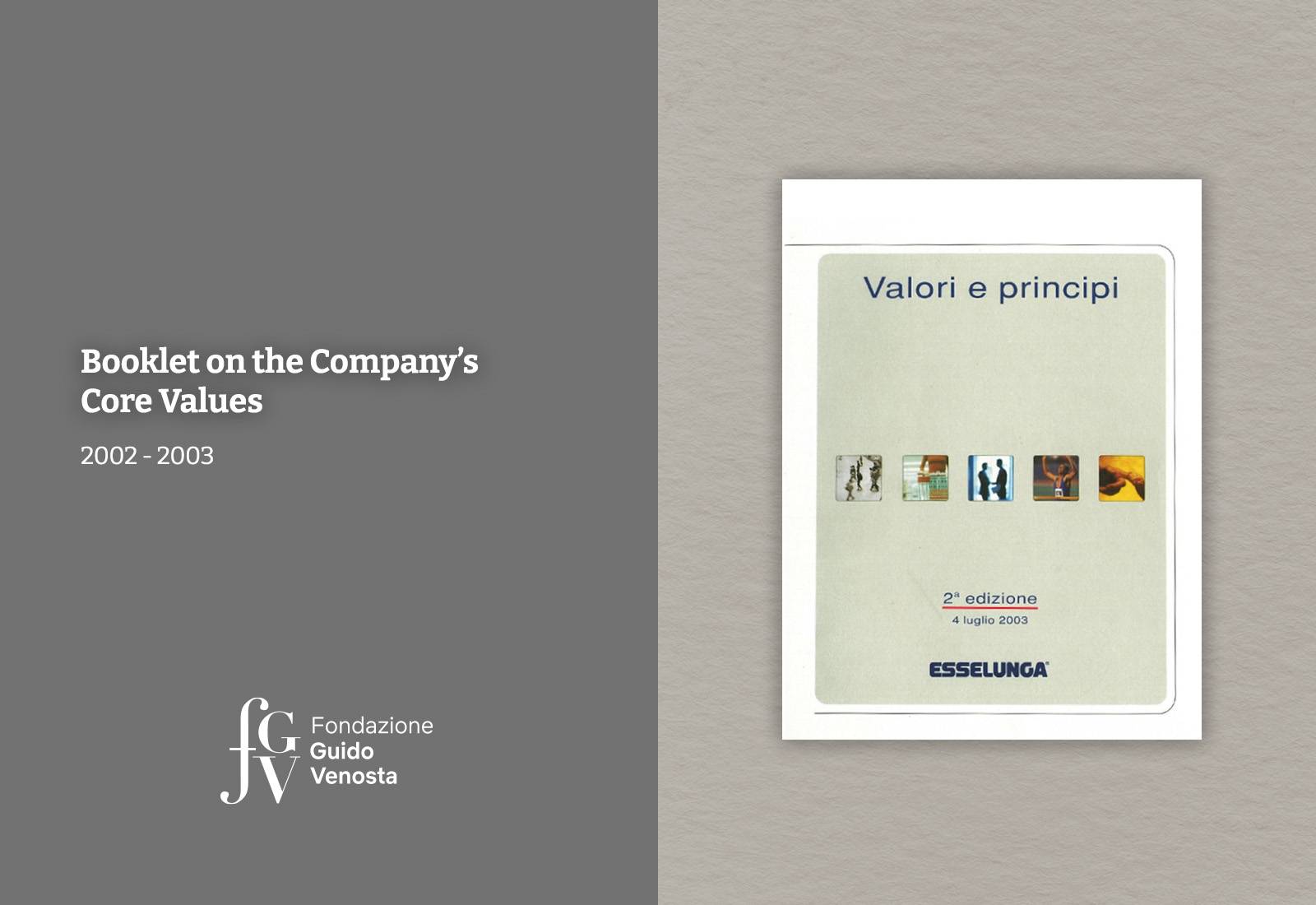
To me, the customer is not just a user, but a key player — the company’s most valuable asset. Between 2002 and 2003, both the internal booklet “Valori nei fatti” and the first Social Report made it clear: our corporate policy puts customers at the center.
It’s not just about market analysis, or suggestion boxes in stores (which were all read and taken seriously — remember, the internet didn’t exist yet), nor is it only about “wowing” customers by meeting or even exceeding their expectations. It’s about building an ongoing, active relationship based on trust — and trust stems from information.
I don’t want customers to buy what we decide for them. I want them to tell me — directly or with the vital help of our staff — what they really want.
With this “From I to We” approach, for the first time, information started flowing from the bottom up. All store managers were encouraged to report customer requests via email or through their area inspectors. In many other cases, whether during inspections or in-store meetings, we asked store leaders directly. We also held weekly planogram meetings where sales staff — inspectors and store managers — came prepared with proposals based on product category revisions. These ideas were discussed with marketing and purchasing teams. (See pages 163–165 of “Le ossa dei Caprotti – Una storia italiana,” Feltrinelli, 2023.)
As the first supermarket chain in Italy, Esselunga turned this customer relationship into a reality by adopting a loyalty card, already popular abroad. I was familiar with the system from seeing it used by competitors like Dominick’s and American airlines. Esselunga’s card was called Fìdaty, because it was built on trust.
Those who held the card gained access to exclusive discounts and offers, received the Speciale News magazine (nicknamed Fragola News, which reached up to a million subscribers), and were offered articles and recipes on topics ranging from health and wellness to childcare, savings, organic food, and fair trade — all tailored to customer interest and curiosity.
Fìdaty launched in 1995, following a test the previous year. Within ten years, 91% of total sales were processed through the loyalty card. By the early 2000s, over 90% of catalogue points were redeemed. In 2003, with a points promotion that doubled the strawberry points, redemption reached 115% (out of a theoretical 200%).
Then there were the discount coupons — inspired by American models — which at times reached a redemption rate of 7–8%. Grocery discount vouchers had redemption rates of over 30%, although they remained mostly “invisible” due to their high cost. (In marketing, redemption refers to the percentage of responses relative to the total number of distributed offers — and in both cases, the performance was excellent.)
Notably, in 2003 the products listed in the Fìdaty catalogue represented €80.9 million in cost value (source: Esselunga Marketing Plan 2004). Fìdaty helped move products off the shelves, but also sold many others that weren’t in the standard assortment, thanks to the catalogue itself.
Through advertising within the magazine and special promotions, the loyalty program also contributed to a significant increase in promotional contributions — helping boost Esselunga’s operating profit by 2.5 times between the late 1990s and the early 2000s.
In conclusion, discount coupons, grocery vouchers, an appealing product catalogue, engaging magazines, and strong partnerships all contributed to making Fìdaty a truly unique program.
And at that time, so too was home delivery and e-commerce — still rare in the Italian retail world.
Alongside these services were many others: holiday food reservations, photo development, the ability to buy single units of fresh produce, in-store cafés, children’s play areas, perfumeries, newspapers, phone cards, and pre-sliced meats and cheeses.
Listing everything is nearly impossible. But one thing is certain: the quality of our products and services led many customers to build what can only be described as a true “love story” with Esselunga.
Bibliography
Caprotti, G. (2024). Le ossa dei Caprotti. Una storia italiana. Milano: Feltrinelli.
Caprotti, G. Dall’io al noi: le risorse umane
Caprotti, G. (22/02/2022). Storia: Valori e principi delle Risorse Umane di Esselunga
Caprotti, G. (16/03/2025). Storia: I valori nei fatti. La responsabilità sociale di Esselunga
Caprotti, G. Il localismo toscano di Esselunga
Caprotti, G. Le origini della Fidaty
Caprotti, G. Il risultato operativo di Esselunga