
Giuseppe Caprotti’s Social Commitment at Esselunga: People – the Suppliers
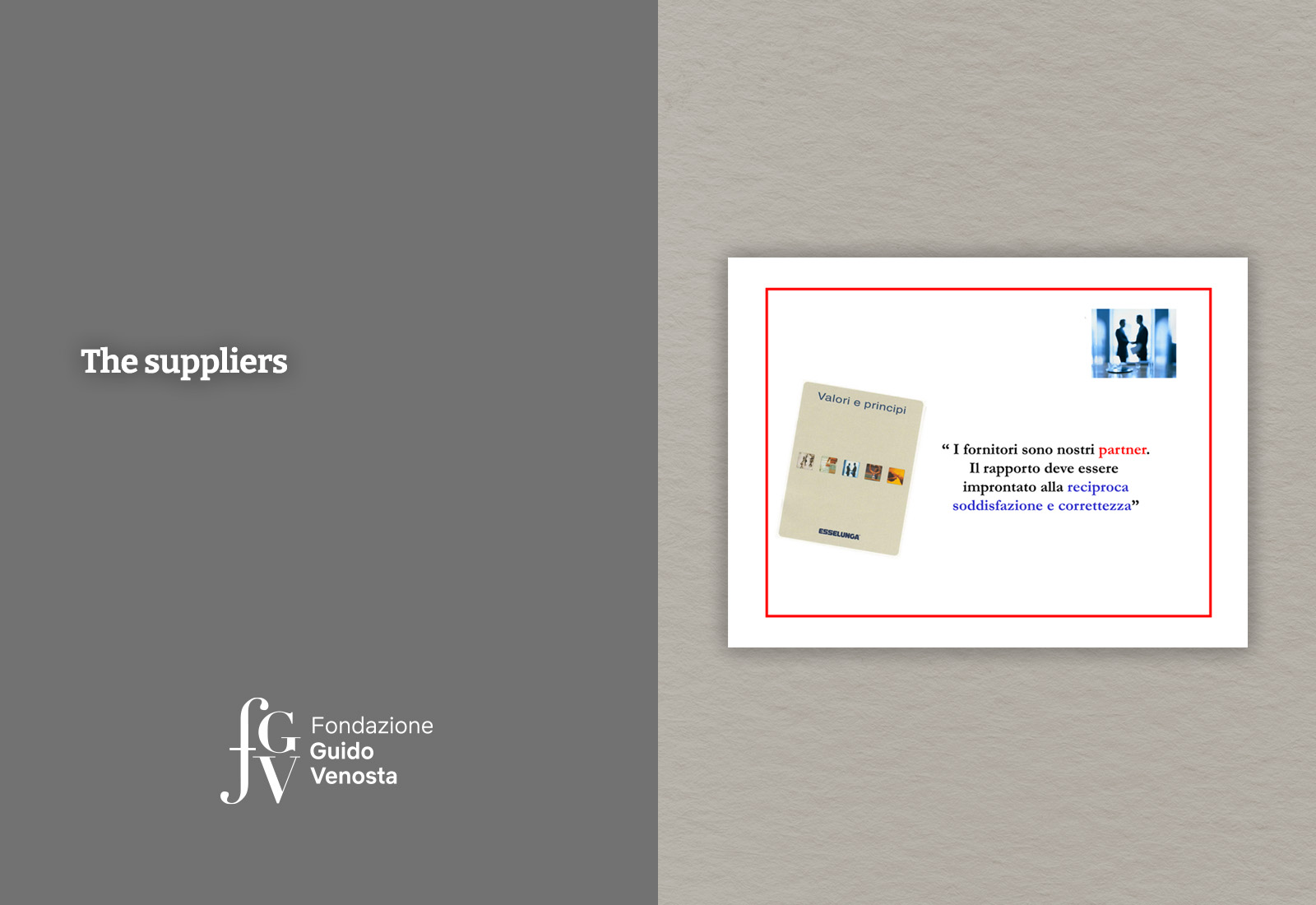
Just as we do with our customers, we also follow a clear protocol for our suppliers, who are true partners of the company.
My father, Bernardo Caprotti, always treated them with the utmost fairness and respect — starting with a fundamental principle: punctual payments. Our payment terms were consistently much shorter than the industry average.
We have carried on this approach, strengthening the existing practices. In 2001, ESD — the purchasing alliance co-founded with Selex — recorded an average payment term of 86 days, 24 days below the market average.
Esselunga’s own average was even lower.
Suppliers also know that our logistics operations are more cost-efficient compared to others: delivering goods to just two warehouses (in Milan and Florence) is much simpler than distributing to dozens of hypermarkets scattered across Italy. That’s what the table under “allocations per decision point” refers to.
Then there are the rules:
- We don’t accept gifts
- We cover the cost of supplier visits and trade fair attendance ourselves
- We minimize delivery wait times
- We meet suppliers promptly and on time
- We always honor our commitments (e.g., promotions)
I have always prioritized impartiality in supplier selection, promoting collaboration, fairness, and transparency. At the same time, I have deliberately supported “local economic activities and employment by giving preference to small and medium-sized suppliers” (i.e., those with annual revenue below €100,000; in 2003, at the time of the first Social Report, they represented about 70% of the total).
I’ve worked to highlight the value of Italian SMEs, “promoting the sale of domestic products and the protection of traditional production.” These products were offered locally to customers who knew and appreciated them — and were happy to buy them.
It may seem obvious today, but at the time, Esselunga followed a very different policy: product selection was dictated top-down, and many excellent, traditional items — unknown in stores located far from their region of origin — remained unsold. Changing that approach was one of the great revolutions that reshaped the identity of Esselunga.
On the other hand, suppliers know we don’t play games. We have taken part in three major antitrust actions: one against the book pricing cartel, one against the baby food market, and another against Coca-Cola for abuse of dominant position.
The most notable case was in the late 1990s, when we took on a giant like Coca-Cola. They tried to impose their own rules on us as distributors of their products — but we fought back and won.
“From that moment on,” I wrote, “other suppliers, before taking actions that might harm us, started reaching out to understand what our response would be.” (Caprotti, Le ossa, p. 184).
It was a well-deserved victory — and a powerful one in securing long-term respect.
From fair payment practices to clearly defined rules, our suppliers have always been considered key partners in Esselunga’s “virtuous circle” of people–customers–suppliers.
During the presentations of my book Le ossa dei Caprotti, held around Italy, I received heartfelt messages of appreciation from suppliers. Even after two decades since my departure, many confirmed that my policies had left a lasting, positive mark.
Bibliography
G. Caprotti, Le ossa dei Caprotti. Una storia italiana, Milano, 2024/3.
ID., Il localismo toscano di Esselunga
ID., Storia: Valori e principi delle Risorse Umane di Esselunga, 22/02/2022.
ID., Storia: i valori nei fatti. La responsabilità sociale di Esselunga, 16/03/25.
ID., Esselunga contro Coca-Cola
ID., Esselunga nella Centrale ESD Italia, punto 4°: il metodo e i risultati. Nel ricordo di Sergio Pelassa