High drinking water losses and weaknesses in the national water network
High drinking water losses and weaknesses in Italy’s national water network
Every year, a significant share of the drinking water entering Italy’s distribution networks is lost before it reaches end users. Within the European Union, over the 2022–24 period, Italy ranked second only to Romania in terms of the percentage of water lost.
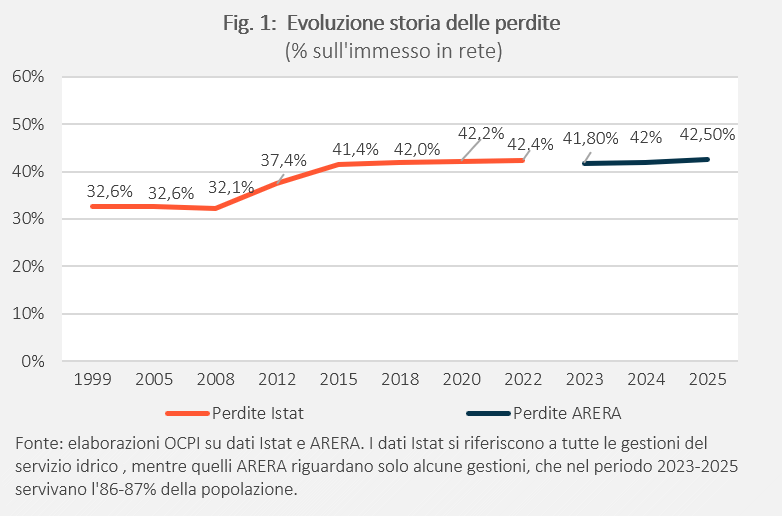 Efforts to address the problem are hampered by the lack of timely and comprehensive national data. The most recent estimates come from ARERA and cover only part of the population, albeit a significant share. They indicate a slight worsening in water losses between 2022 and 2025.
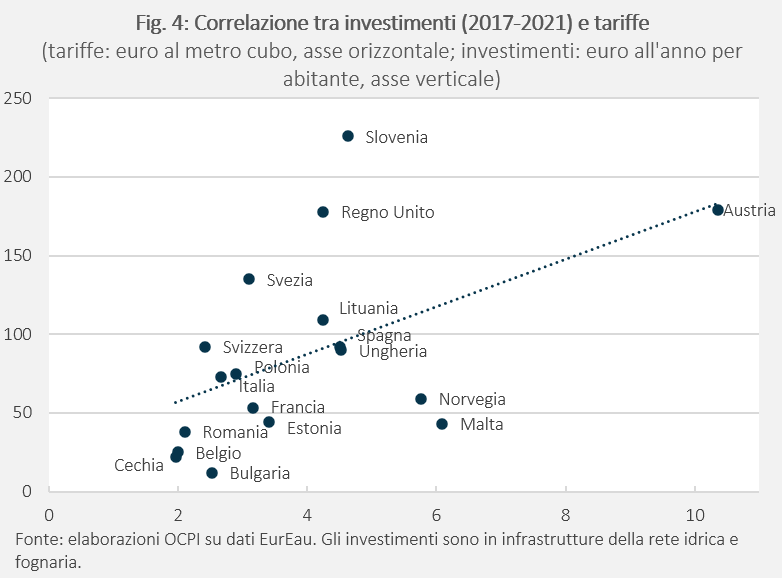
International comparisons suggest that higher water tariffs encourage greater investment, which in turn helps reduce water losses.
Italy, however, has some of the lowest water tariffs in Europe, reducing the resources available to modernise the network. In response to this critical situation, funds from the NRRP () have been allocated to projects aimed at improving the water network, but it is unclear what has actually been implemented.* Moreover, no quantitative target was set for reducing water losses. The tangible effects of these interventions on the network will therefore only become apparent in the coming years.
Every year, a significant proportion of the water entering Italy’s distribution networks is lost before reaching end users. Unfortunately, the latest complete data on water losses published by Istat — and still widely reported by the media — date back to 2022 and relate only to water for civil use.[1]
Historical evolution of water losses – OCPI-847, Fig. 1

For non-drinking water used in agriculture and industry, no nationwide statistics are available.[2] The lack of timely and consistent national data published by Istat on drinking water losses highlights a fundamental weakness in water network management: effective interventions require up-to-date information capable of rapidly identifying the areas affected by losses and guiding maintenance work accordingly.
That said, the situation in 2022 was far from reassuring. In that year, around 8 billion cubic metres of drinking water entered Italy’s municipal water networks, equivalent to 371 litres per inhabitant per day. Of this amount, only 4.6 billion cubic metres — 214 litres per inhabitant per day — were actually supplied to users (Fig. 1). The difference, 3.4 billion cubic metres, was lost.[3] As a result, the amount of water lost would have been sufficient to meet the needs of almost 75% of the Italian population, equivalent to around 43.4 million people.
The problem has worsened over time: in 2022, losses as a percentage of the water entering the network were around 10 percentage points higher than at the time of the first survey in 1999. Partial data from ARERA — the Italian Regulatory Authority for Energy, Networks and Environment — suggest that there had been no improvement by 2025, while no information is currently available for 2026.[4]
… Water losses are caused by deteriorating infrastructure and illegal connections.[6] According to the Financial Times, however, an underlying cause lies in the management model itself: many networks are operated by small local providers with limited resources, making it more difficult to plan systematic maintenance or replacement programmes.[7]
… There is a positive relationship between water tariff levels and investment: countries with higher tariffs tend to invest more, while Italy ranks at the bottom of the table.