Is the widespread contamination of drinking water reported in France also likely in Italy?

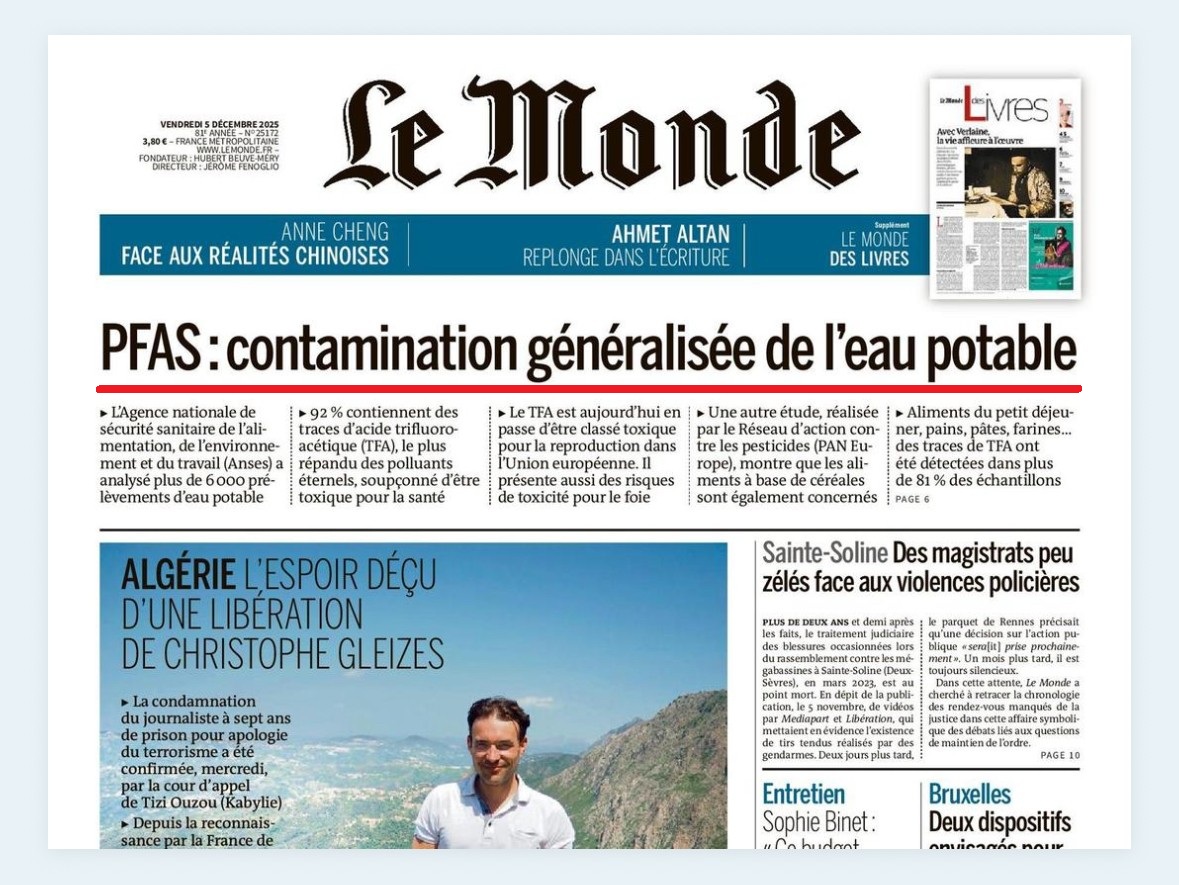
Below is an excerpt from an article about PFAS that recently made the front page of Le Monde in France.
PFAS: Widespread contamination of drinking water by TFA, the most prevalent “forever chemical”
The French Agency for Food, Environmental and Occupational Health & Safety (ANSES) analyzed more than 600 drinking-water samples nationwide: 92% contained traces of trifluoroacetic acid (TFA), the smallest PFAS, suspected of being harmful to health.
By Stéphane Foucart and Stéphane Mandard
A new warning has been issued about the quality of drinking water in France. Following alerts from non-governmental organizations (NGOs), the French Agency for Food, Environmental and Occupational Health & Safety (ANSES) revealed widespread contamination of French drinking water by trifluoroacetic acid (TFA)—the most prevalent of the persistent pollutants—in a report published on Wednesday, 3 December. This PFAS, the smallest of the per- and polyfluoroalkyl substances, was found in more than 92% of tap-water samples collected as part of the largest national assessment campaign ever conducted by ANSES.
Between 2023 and 2025, more than 600 tap-water samples and an equivalent number of raw-water samples (drinking water before treatment) were analyzed. These samples came from river basins across the country and represented around 20% of the water distributed in France. The ANSES campaign did not include bottled water: analyses carried out in 2024 by Pesticide Action Network Europe showed that mineral waters were also contaminated by TFA.
By accumulating in the environment, TFA poses a growing threat to public health: it is now on track to be classified as toxic for reproduction in the European Union (EU) and also shows signs of liver toxicity.
The results of the detection campaign conducted in France on drinking water (which accounts for about 20% of PFAS exposure) show an average TFA concentration slightly above 1,000 nanograms per liter (ng/L), with a maximum value of 25,000 ng/L for a sample of water from a drinking-water treatment plant located downstream from a TFA production facility—demonstrating the current ineffectiveness of treatments.
Until now, the record in France was 13,000 ng/L, for a sample taken from the tap in the town of Moussac (Gard), located near a Solvay group plant that produced TFA until September 2024. “I have never seen such levels of TFA concentration in drinking water,” comments environmental chemist Hans Peter Arp, one of the world’s leading TFA experts. “And these concentrations will continue to rise due to the expected increase in concentrations of TFA precursors [fluorinated gases, pesticides, etc.] in ecosystems.”
A metabolite of several pesticides
However, ANSES notes that TFA concentrations are below the “health-based guidance value” adopted by the Directorate General for Health, pending clarification of EU regulation.
In a note quietly published on 23 December 2024, the French Directorate General for Health aligned itself with the provisional German value of 60,000 ng/L, below which the risk is presumed to be zero. However, health authorities are maintaining “a reduction trajectory toward a concentration below 10 micrograms per liter [i.e., 10,000 ng/L].” Two samples taken as part of the ANSES campaign showed concentrations above this 10,000 ng/L target value. Other countries, such as the Netherlands, have adopted a health value almost five times lower: 2,200 ng/L.
These indicative, provisional values will be harmonized once the European Food Safety Authority (EFSA) has established a reference value—namely, a tolerable daily intake of TFA from all sources of exposure. Its conclusions were expected by the end of the year, but have been postponed to July 2026…
… On average, all samples taken by ANSES exceeded the regulatory threshold of 100 ng/L by a factor of ten. This means that tap water should be declared “non-compliant” for the vast majority of French citizens if TFA were considered a relevant pesticide metabolite. In addition, the ANSES analysis campaign reveals the unique nature of TFA: its presence is not statistically associated with that of other PFAS. This characteristic suggests other pathways of environmental contamination, such as atmospheric deposition, notes Xavier Dauchy (Nancy Hydrology Laboratory), who co-led the analysis campaign.
Below, on the front page of Le Monde, whose main headline concerns PFAS, the paper denounces the fact that they are present not only in water but also in food—especially wheat-based products. It is written above, but it is worth reiterating: PFAS (TFA) have also been detected in mineral waters.