Happy: a Community Project for the Psychological Well-Being of Adolescents
Promoting Entities
- Guido Venosta Foundation
- Minotauro, Institute for the Analysis of Affective Codes, Milan
- CDS – Le Comunità della Salute
- CSV Milano ETS – Metropolitan City, Volunteer Service Center, Milan
- CSV Monza Lecco Sondrio ETS – Volunteer Service Center
Following the WHO/Europe guidelines “Nothing about us, without us” for the active involvement of adolescents and young people in decision‐making processes regarding their health, Happy – the Prevention and Support Intervention Project for the Psychological Well-Being of Adolescents in the Milan metropolitan area and the Province of Monza and Brianza – is born.
After the pandemic emergency phase, a general decline in young people’s well-being has indeed been observed. The ways in which adolescents express their distress have changed and now require new intervention perspectives capable of addressing an increasing complexity. The network of services and educational agencies involved in care and development needs to build integrated interventions that promote a shared understanding of the evolving needs of adolescents and sustainable growth projects. Out of these necessities, the HAPPY project is conceived and developed.
In line with these premises, the project’s objective is to prevent the emergence of issues related to body attacks (suicide attempts and eating disorders) and social and school withdrawal by engaging young people in active educational activities. Equally central is raising awareness and involving the broader community, including citizens, parents, and the entire educational ecosystem.
Objectives
- Promote the active involvement of young people in their decision-making processes and in shaping their future within educational, sports, recreational, and socio-cultural promotion contexts, through volunteer internships with practical assignments in various associations.
- Support adults and strengthen the educational community by facilitating synergies between local associations and the relevant territory.
- Foster projects of cultural and participatory promotion.
Project Strategies
- Build networks and forms of cooperation among participating stakeholders.
- Map territories and conduct an analysis of the specific, real needs of young people.
- Develop support and awareness-raising actions for parents and the educational community.
- Create training initiatives for professionals and teachers.
- Organize cultural promotion and solidarity activities, and encourage the active participation of young people in their communities, including targeted interventions for youths not attending school and for workers aged 14 to 25, who are typically not addressed by policies aimed at active involvement.
Locations
- Municipio 7 (Baggio, De Angeli, San Siro), Milan.
- Municipality of Sovico (MB).
- Municipality of Seregno (MB).
These are different locations with varied population densities and socio-cultural environments, each requiring tailored, focused interventions.
Project Target
- Adolescents attending lower and upper secondary schools.
- The adult population/educational community (parents, teachers, etc.).
- Associations and/or informal groups in the target territories—that is, groups sharing similar characteristics to formal groups (direct relationships among members, affective integration, a sense of “us”) but that spontaneously aggregate in specific places (such as a courtyard, a football field, or a square), adopting a specific jargon and distinctive traits (dress codes, tattoos, etc.), and which generally compete with other similar groups.
PROJECT ACTIONS
November 2023 – May 2024
READING THE NEED AND BUILDING THE PROJECT
The first phase of the plan aims to engage with the selected territories to identify specific needs and resources. This is a highly innovative aspect, as it intends to create ongoing local activities that promote adolescent and educational community well-being based on listening to and understanding the actual, specific needs inherent to each territory. Only based on the outcomes of this first year of need analysis, engagement, and support will tailored projects and activities be developed for each area, with young people themselves and all those involved in their growth and well-being taking an active role from the earliest stages of ideation.
This initial phase comprises four actions, to be implemented on a continuous basis:
Action 1 – The Steering Committee and Project Building
- Meetings of the “steering committee” (i.e., the phase that integrates vision, planning, coordination, and concrete action) and monitoring of the project actions and their results, involving all project partners.
- Back-office work for planning and coordination.
Action 2 – Mapping to Build the Network
- Mapping each territory to identify existing resources and volunteer associations—both public and private—and providing any necessary training support. (Carried out by the CSVs.)
- Connecting with the network of schools and public services, as well as private social services present in each territory. (Also coordinated by the CSVs.)
Action 3 – Analysis of the Needs of Different Territories
- Identifying the specific needs of each territory, which will serve as the basis for launching the second-year project planning. (Managed by Minotauro Milan with support from CSV Milano and CSV MLS.)
- Conducting in-depth interviews with key figures from territorial organizations. (Managed by Minotauro Milan.)
- Organizing focus groups on the needs and resources present in each area with samples of young people, professionals, and parents (three groups, each lasting two hours, conducted by psychologists experienced in cultural analysis). (Managed by Minotauro Milan with support from CSV Milano and CSV MLS.)
- Analyzing the collected material, producing outputs, and providing feedback.
Action 4 – Designing Tailored Interventions for Each Area
- Workshops for developing the projects to be implemented in the different territories, involving all project partners.
Possible Project Pathways
For Young People:
- Support for personal and collective well-being; helping youths discover and enhance their resources; developing effective tools to meet societal demands.
- Prevention sessions in schools (per class) addressing the onset of psychological and behavioral issues.
- “Laboratories of Doing” tailored for each local area to strengthen self-awareness.
- Provision of psychological support for the most vulnerable youths identified during territorial work.
- Cultural and participatory events. For example, engaging youths in creating and watching theatrical performances—recognizing the therapeutic role of theatre, which can broaden minds and horizons and shed light in dark, heavy times. An example is a performance of “Chi come me,” written by playwright Roy Chen and staged at Teatro Parenti by Andrée Ruth Shammah, which tells the story of five young people undergoing treatment at a mental health center in Tel Aviv, demonstrating that our young people are not alone in facing future trauma and overwhelming anxieties.
For Parents:
- Workshops/activities to raise awareness on adolescence and growth; providing perspectives to interpret warning signs and adolescent distress; developing new tools that enable adults to support and promote new growth experiences.
- Conferences and community meetings.
- Training cycles for professionals and volunteers.
- Training sessions for teachers.
- Meetings with parents.
Action 5 – Specific Training on Adolescence and Tools for Managing Distress
- Targeted at all members of the educational community. Organized by the Minotauro Institute with support from CSV Milano and CSV MLS.
- A training cycle, delivered in-person or online, consisting of three sessions of four hours each covering topics such as adolescence, new growth patterns, emerging forms of distress, and the resources available to the educational community (including association operators, school staff, volunteers, and parents), always with the active participation of the young people involved. (Managed by the Minotauro Institute.)
DURATION
The project is envisioned over a minimum period of three years and has been designed flexibly to integrate activities based on emerging needs and available funding.
To ensure the organic and structured growth of the project, it will be essential to use concrete and tangible criteria that operate in two directions: on the one hand, serving as management tools for the activities to be carried out (number of conferences, workshops, events, organizations involved, etc.); on the other, to highlight progress (attendance, registrations, organizations involved, etc.) from one year to the next. These data will also be used to engage additional sponsors, both financial and in-kind contributions (i.e., through the provision of goods, services, free labor, etc.), which will become an integral part of the project’s growth.
CURRENTLY
Municipio 7, Milan
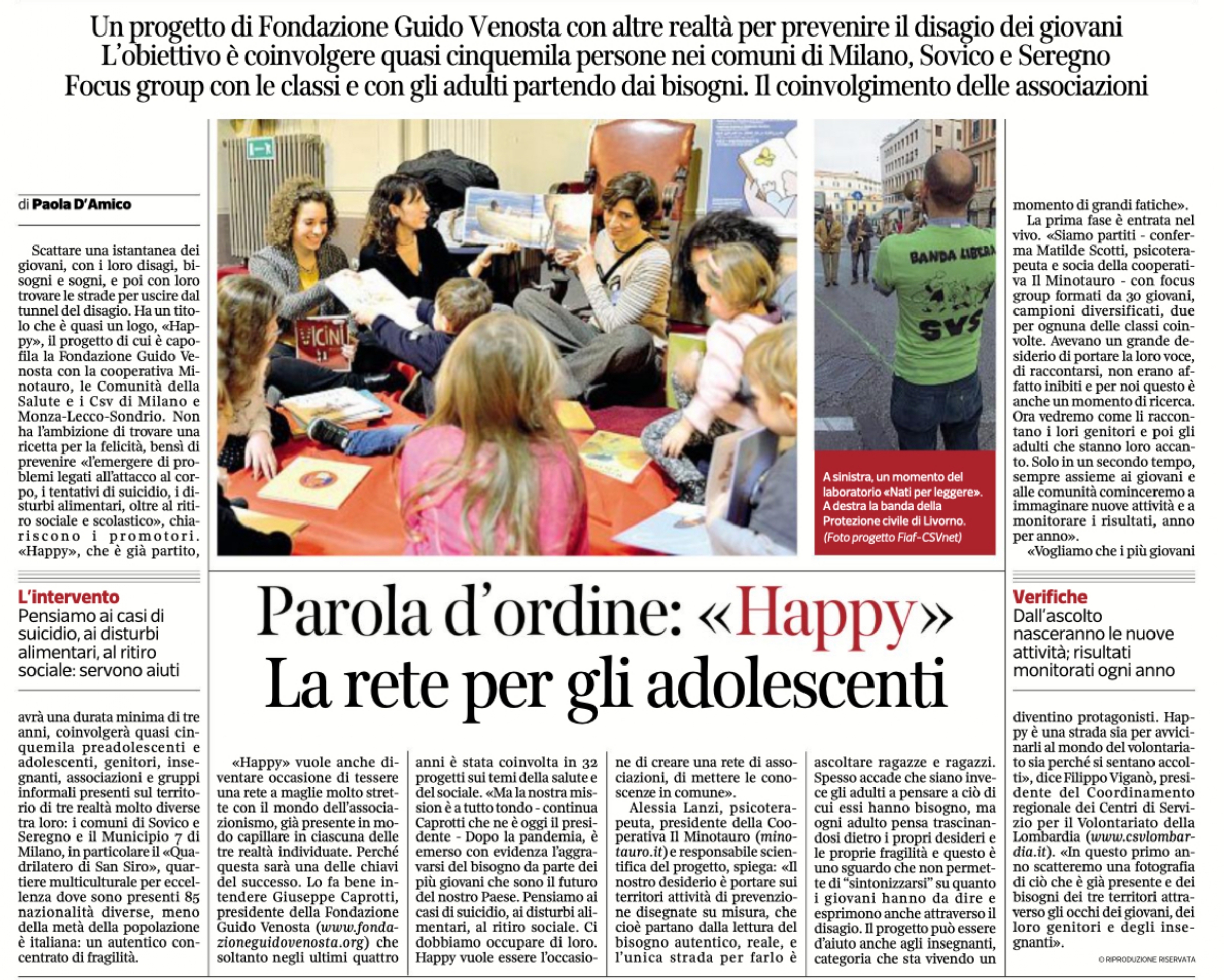
In Municipio 7, actions are being taken in an area between Piazza Selinunte and Piazzale Segesta, located in that “Quadrilateral of San Siro,” which is one of the highest-risk zones in the city. For example, data from the Azienda Lombarda per l’Edilizia Residenziale show that 45% of residents in public housing (ERP) have an ISEE of €7,319.00 or less per year. The HAPPY Project’s intervention in this microzone was also prompted by the interest of Don Franco Molteni—formerly parish priest of Albiate and now assistant at the parish of Beata Vergine Addolorata in San Siro—where Italians and Christians have become a minority, predominantly elderly.
The parish’s neighborhood has approximately 12,000 inhabitants, 45–50% of whom are of foreign origin (representing 85 nationalities). The youth population is about 15% (ranging from 0 to 18 years old), with over half of them of foreign origin and largely of the Muslim faith. In the church’s youth center, a project called “Il Villaggio” has been held for several years. This initiative brings together middle school students from both religious communities, who meet to pray according to their respective faiths and to get to know one another, helping each other navigate the complexities of life in a city like Milan. The premise is an educational pact signed by both the young people and their parents; and since it appears to work—youth who entered the first year of middle school now serve as volunteers, while others gain self-confidence and the courage to express themselves and interact with others—the youth center of the Addolorata parish has become an “episcopal observatory for intercultural and interreligious dialogue” within the Youth Ministry. This pilot project could potentially be replicated in other neighborhoods (see, for example, S. Ballatore, San Siro, l’oratorio dove imam e suore lavorano insieme per dare un futuro di pace ai ragazzi, in Il Giorno, October 14, 2023; C. Pellizzoni and F. Annibali, Il Villaggio: dove crescere insieme e costruire la pace, in Famiglia Cristiana, no. 11, March 17, 2024, pp. 32–35; AGENZIA NOVA, Pasqua: cristiani e musulmani che pregano insieme, alternativa alla strada della Parrocchia di piazza Esquilino, March 31, 2024).
The target for this area is estimated at around 1,500 pre-adolescents/adolescents who live in or frequent the neighborhood (local school attendance, sports associations, etc.), the majority of whom, as mentioned, are of foreign origin. About twenty local associations are active in the area, and it is hoped that more can be involved.
Municipality of Seregno
The first “zone” that actively joined the project is the “Giuseppe Parini” Humanities High School. The Institute has three campuses—two within the municipality and one in Lissone—with three study tracks (Human Sciences, Socio-Economic, and Linguistic), 58 classes, and approximately 1,300 students (distributed across the three campuses). A distinctive feature of “Parini” is its Educational Space, where students with and without disabilities participate in laboratory activities (including theatre, yoga, horticulture, object-making, art therapy, music therapy, and others). This unique experience in secondary education places the Institute at the forefront of inclusive didactic-educational activities. The HAPPY Project will support the coordination of the educators working in the Educational Space by training them according to the latest criteria to better address emerging challenges.
Municipality of Sovico
In this area, too, the first school to join was the “Giacomo Paccini” Comprehensive Institute of Sovico, a primary institution (covering preschool, primary, and lower secondary education) with 37 classes and about 750 students. It was named after a principal who, in the 1970s, aimed to create a music-oriented school where learning to read musical scores, listening, and playing were of utmost importance; music, by its very nature, is inclusive. This distinctive characteristic will be further developed with the support of the HAPPY Project.
Between Seregno and Sovico, the project’s target is estimated at about 2,000 youths aged between 12 and 16 years. This number may quickly increase, as several associations of various kinds have already expressed interest (e.g., a local pro loco and a sports association). Data will be updated accordingly.
The Municipality of Seregno has about 140 associations, while Sovico has 40; all will be informed and, if possible, involved.
The most pressing matter is that what is achieved should persist as much as possible and be self-sustaining, continuously creating positive conditions that enrich the territories where the project has operated and improve the lives of those who live there.