
Giuseppe Caprotti’s Social Commitment at Esselunga: People and Solidarity
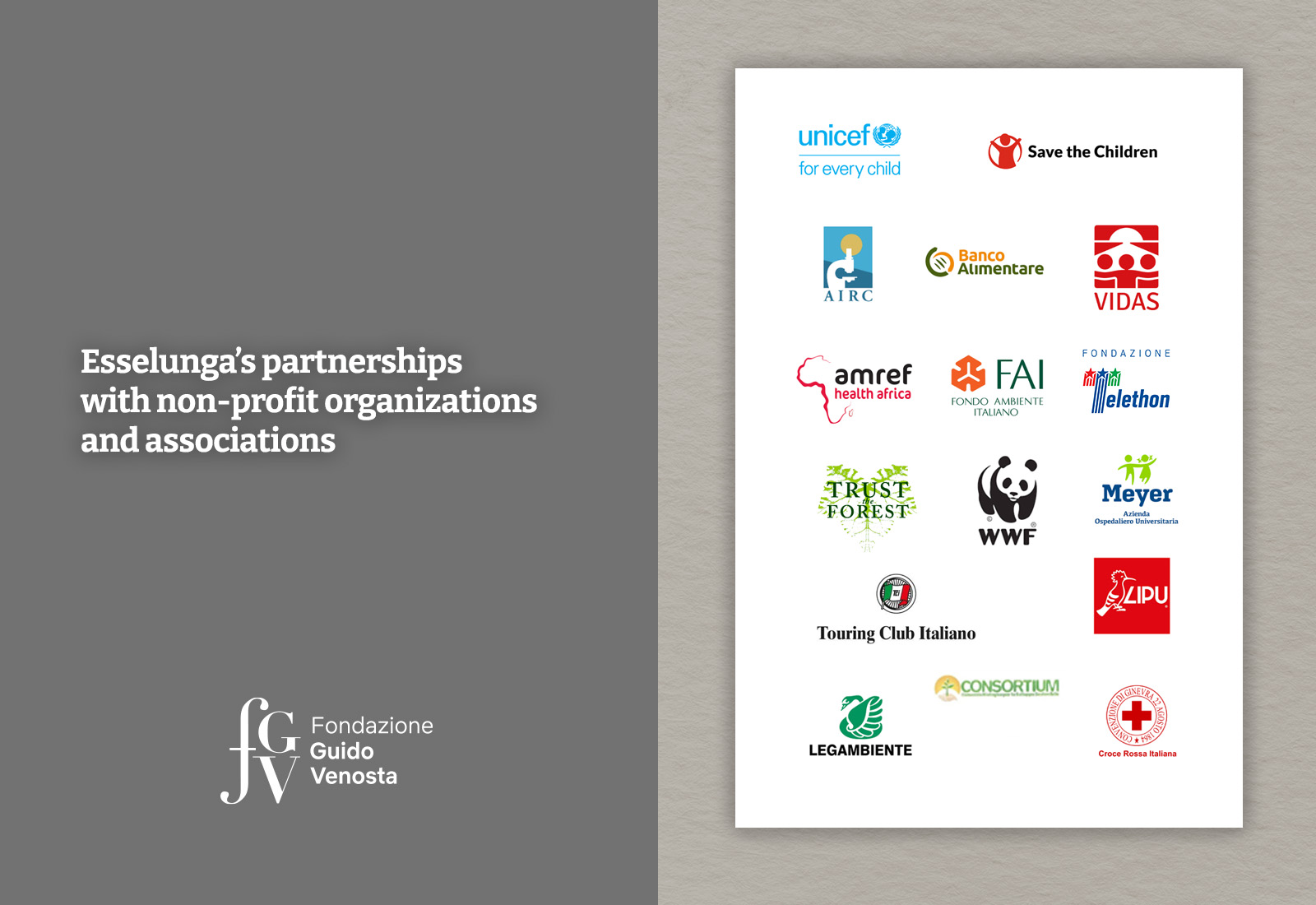
The first Social Report issued by Esselunga dates back to 2003, but even before I joined the company in 1986, it had already established important relationships with organizations such as VIDAS, AIRC, the Red Cross, Telethon, FAI, and Banco Alimentare.
In addition to the major contribution of Aldo Ferraro—who was behind the collaboration with Banco Alimentare—I fondly remember the local initiatives promoted by accountant Giovanni Maggioni. For instance, while I was already working in marketing, he brought the Meyer Pediatric Hospital in Florence on board as an Esselunga partner.
Over time, our relationships with VIDAS, AIRC, FAI, and Banco Alimentare were strengthened and deepened.
As with the commercial side of the business, all charitable initiatives were carried out with genuine passion and nurtured through relationships with people committed to meaningful and compelling causes.
My role models—besides the late Danilo Mainardi, with whom I carried out my first environmental project in support of LIPU (introducing storks to the Ticino Park, followed by swallows)—also included Giovanna Cavazzoni (VIDAS) and Giulia Maria Crespi (FAI). I developed with both women a deep mutual respect and affection.
This spirit, this passion, engaged the entire company throughout the 19 years I worked there. And not just in words: sustainability also became part of the company’s identity, from organic and fair trade products to eco-friendly packaging, from energy-saving policies to the design of new stores with the lowest possible environmental impact.
Alongside sustainability, there was solidarity: that deep human sense of care and compassion for others that goes beyond mere assistance—or not always assistance alone—and instead builds a path of real help, recovery, and opportunity, enabling people to find their own place in the world and move forward independently.
Ultimately, there were four guiding pillars: support for research, solidarity, the arts, and sustainability.
In Esselunga’s first Social Report of 2003, it is clearly stated that the company “is committed to supporting social projects by sponsoring scientific research and the activities of humanitarian and charitable organizations,” and to “contributing to the preservation of artistic and natural heritage through environmental protection initiatives and awareness campaigns.”
The method was simple and effective: holders of the Fìdaty Card, Esselunga’s loyalty card, could donate a portion of their accumulated points to the initiative of the moment. At the checkout, customers could also purchase vouchers with pre-set amounts which, in cases such as the partnership with FAI, gave them free access to sites that had been restored and protected.
Esselunga would then match the points donated by its customers.
I would like to emphasize how this often brought the circle of collaboration between employees and customers to a close—filled with passion and enthusiasm. I personally witnessed many cashiers encouraging customers to donate their Fìdaty points to various organizations, such as VIDAS.
A Partial Overview of Esselunga’s Collaborations and Projects in 2003:
SOLIDARITY
For UNICEF, the “Vitamin A Operation” raised €283,940 (half donated by 28,934 customers and the other half matched by Esselunga). The “Nevirapine in Zambia” initiative collected €544,440 (again, half from 54,440 customers and half from Esselunga), helping to save tens of thousands of children from the risk of contracting HIV.
For Banco Alimentare, Esselunga has long been donating food products that are still perfectly consumable despite minor imperfections. It also participates in the Food Collection initiative: in 2002 alone, 490 tons of foodstuffs were gathered, valued at over €2 million.
For Save the Children, Esselunga joined the “Water for the Sahel” project to provide access to clean drinking water for children in the sub-Saharan Sahel desert. Customers donated €165,350, which Esselunga doubled, bringing the total to €330,700.
HEALTH
For AIRC (Italian Association for Cancer Research)—an organization especially close to Giuseppe Caprotti, whose maternal grandfather Guido Venosta dedicated much of his life to it—Esselunga and its customers donated €250,000 during the “European Week for Cancer Research” (October 6–13, 2002). Esselunga also supports the annual “Oranges for Health” campaign.
For VIDAS (which offers free, comprehensive home care for terminal cancer patients), Esselunga launched a fundraising campaign in September 2002 and, thanks to the generosity of its customers, donated €88,831.
For the construction of a new operating room at the Meyer Pediatric Hospital in Florence, from July to October 2002, Esselunga ran a fundraising campaign across its stores in Tuscany. A total of 160,049 customers participated. Esselunga again matched the donations, bringing the final contribution to €285,049.
For AMREF, a nonprofit healthcare organization supporting millions across Africa, between April and October 2003, Fìdaty Card holders who donated 500 points enabled Esselunga to double their contribution to the Flying Doctors, a team of physicians who, with five light aircraft, provide specialist and surgical care to 80 hospitals in remote and hard-to-reach areas of East Africa.
ENVIRONMENT
For the Italian Touring Club, in 2002 Esselunga sponsored the guide “L’Italia del Biologico” (“Organic Italy”), created in collaboration with Legambiente. It was the first national guide to exclusively list certified organic products, companies, and shops throughout Italy.
For LIPU (Italian League for Bird Protection), and thanks to the personal connection between Giuseppe Caprotti and ethologist Danilo Mainardi, Esselunga was likely the first company in Italy to launch a customer-funded initiative for the protection of swallows. This led to the creation of the Swallow Farm in the Ticino Park, inaugurated in May 2002, and starting that September, involved 80 schools across Piedmont and Lombardy.
For and with Legambiente, Esselunga sponsored the “Clean Up the World” initiative (September 2002) and committed to the “Italian Quality Agriculture” standards for selected Esselunga-branded products (meat, fruits, and vegetables).
For CONSORTIUM, the nonprofit organization for sustainable development and organic education, Esselunga was not only a sponsor but also a founding member.
For WWF Italy, under the leadership of Fulco Pratesi, Esselunga participated in several important environmental campaigns. One notable initiative from the late 1990s helped preserve four monumental trees in Italy, including a magnificent hackberry in San Gimignano.
For the FAI (Italian National Trust), as mentioned earlier, Esselunga has been a consistent supporter, contributing to the protection and restoration of Italian heritage sites preserved by the foundation. The collaboration with FAI began early on, nurtured by a close friendship between Giuseppe Caprotti’s parents, Bernardo and Giorgina, and FAI’s founder and guiding spirit, Giulia Maria Crespi. In 1989, when FAI acquired the medieval Torre di Velate in Varese, Giuseppe’s father contributed to its restoration through Esselunga—well before the launch of the Fìdaty program.
Today, the guiding principles of the Guido Venosta Foundation closely mirror those I adopted at Esselunga.
Bibliography
G. Caprotti, Le ossa dei Caprotti. Una storia italiana, Milano, 2024/3.
ID., Storia: Valori e principi delle Risorse Umane di Esselunga, 22/02/2022.
ID., Storia: i valori nei fatti. La responsabilità sociale di Esselunga, 16/03/25.