
Guido Venosta and the AIRC – the “Yellow Booklet”, or How to Make Solidarity Work (1997)
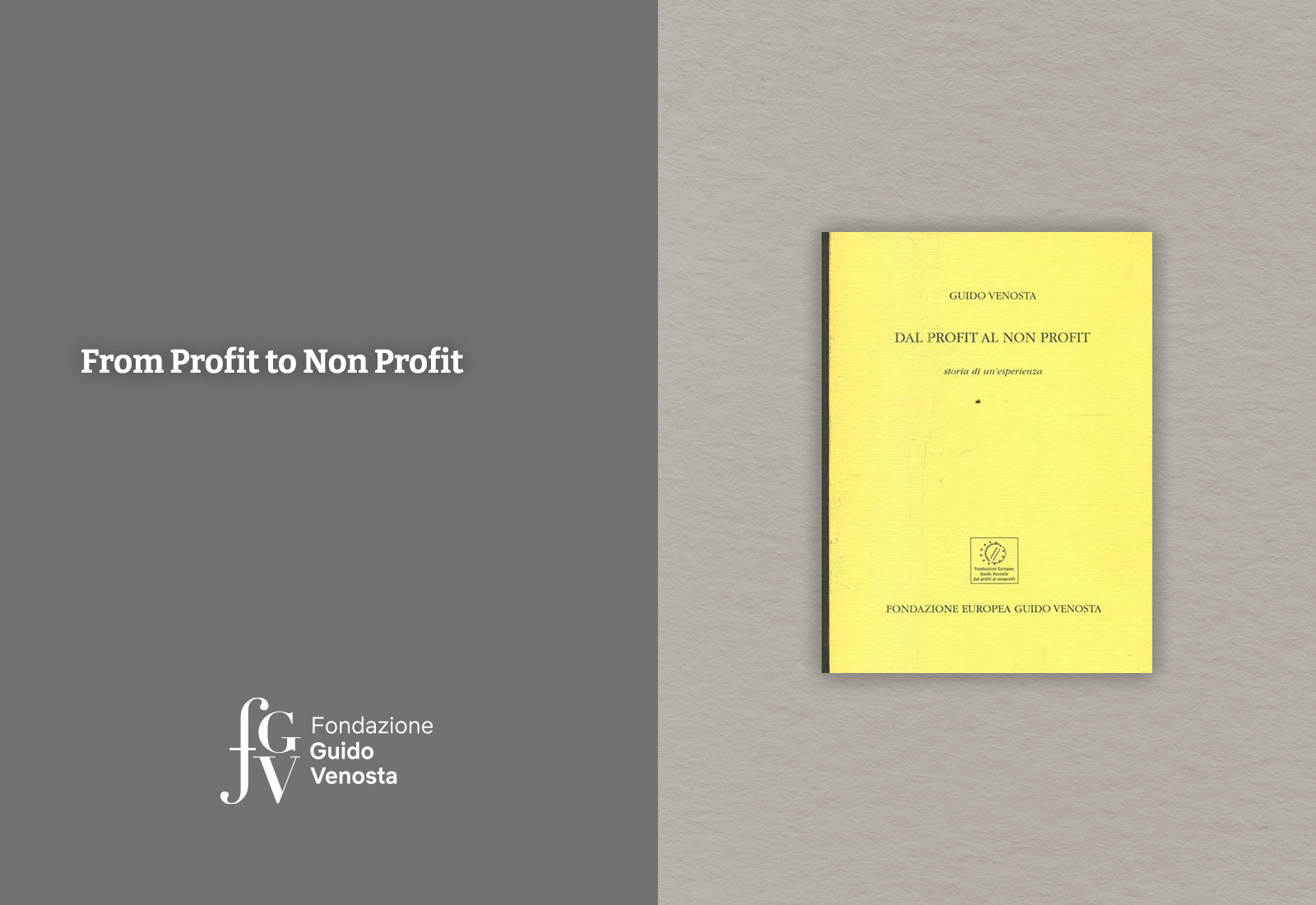
In 1997, Guido Venosta published a small booklet for the Scheiwiller types—modest in format and page count yet rich in content—in which he recounts his personal journey with cancer and the AIRC, outlining the ideas and hopes that drive his actions.
Conceived not for commercial purposes but rather as a tribute, a memento, and above all a call to action, it was sent to a multitude of people along with an accompanying letter that aptly frames and summarizes its message:
“Dear Friend,
In the small essay I have the pleasure of enclosing, I outline the story of my involvement in the fight against cancer; although expressed from an entirely personal perspective, I trust that it will be of some interest to you.
In the 1930s and ’40s of the disease, almost nothing was known. Yet, clearly, a complex enemy like cancer can only be confronted if it is understood, and understanding it requires scientific research. Research, in turn, is all the more effective the broader it is—an aspect that translates into a need for funding; indeed, the Italian Association for Cancer Research was born precisely to try to involve as many people as possible in the active support of that essential quest for knowledge.
Today, considerable progress has been made, and Italian research has reached remarkable milestones, thereby fostering significant advances in therapy.
We have not yet reached the point of completely eliminating the disease, but the path is set and every day marks an important step forward; I therefore believe that the Italian researchers who have consistently and courageously contributed to the AIRC’s efforts have every reason to be very proud of the work they have done.
From “profit” to “nonprofit”—that is, from the world of business and industry to that of solidarity—also represents a proposal, an ideal lens through which to view my experience, suggested with the intent of providing some useful inspiration to all those who carry forward the philosophy of “lending a hand.”
I certainly hope so.
Sincerely,
Guido Venosta”
The booklet, adorned with a vibrant (yet very elegant) yellow cover, received numerous responses—letters addressed both to Guido and, after his passing, to his widow Carla, who in 2004 and 2007 financed two further reprints to ensure that Guido Venosta’s method and his undimmed hope continued to circulate through the power of his words.
These responses came in the form of letters and notes of varying lengths, heartfelt or simply acknowledging his work; among them, perhaps the most beautiful is the brief note from director Giorgio Strehler, with whom Venosta had spent fruitful years of collaboration during the heroic era of the Piccolo Teatro in Milan, when he represented the Municipality:
“Dear Guido,
I have read your illuminating essay, rich in humanity. Thank you for your work, for your sacrifice. This increasingly impoverished world needs men like you.
Warmest and affectionate regards,
Yours,
Giorgio Strehler.”
Sources:
Albiate (MB), Villa San Valerio, Archives of Villa San Valerio, Guido Venosta Foundation Archive, Letter from Giorgio Strehler to Guido Venosta, Milan, November 24, 1997.
Bibliography:
G. VENOSTA, From Profit to Nonprofit. The Story of an Experience, Milan, 1997.