
Guido Venosta – Military service
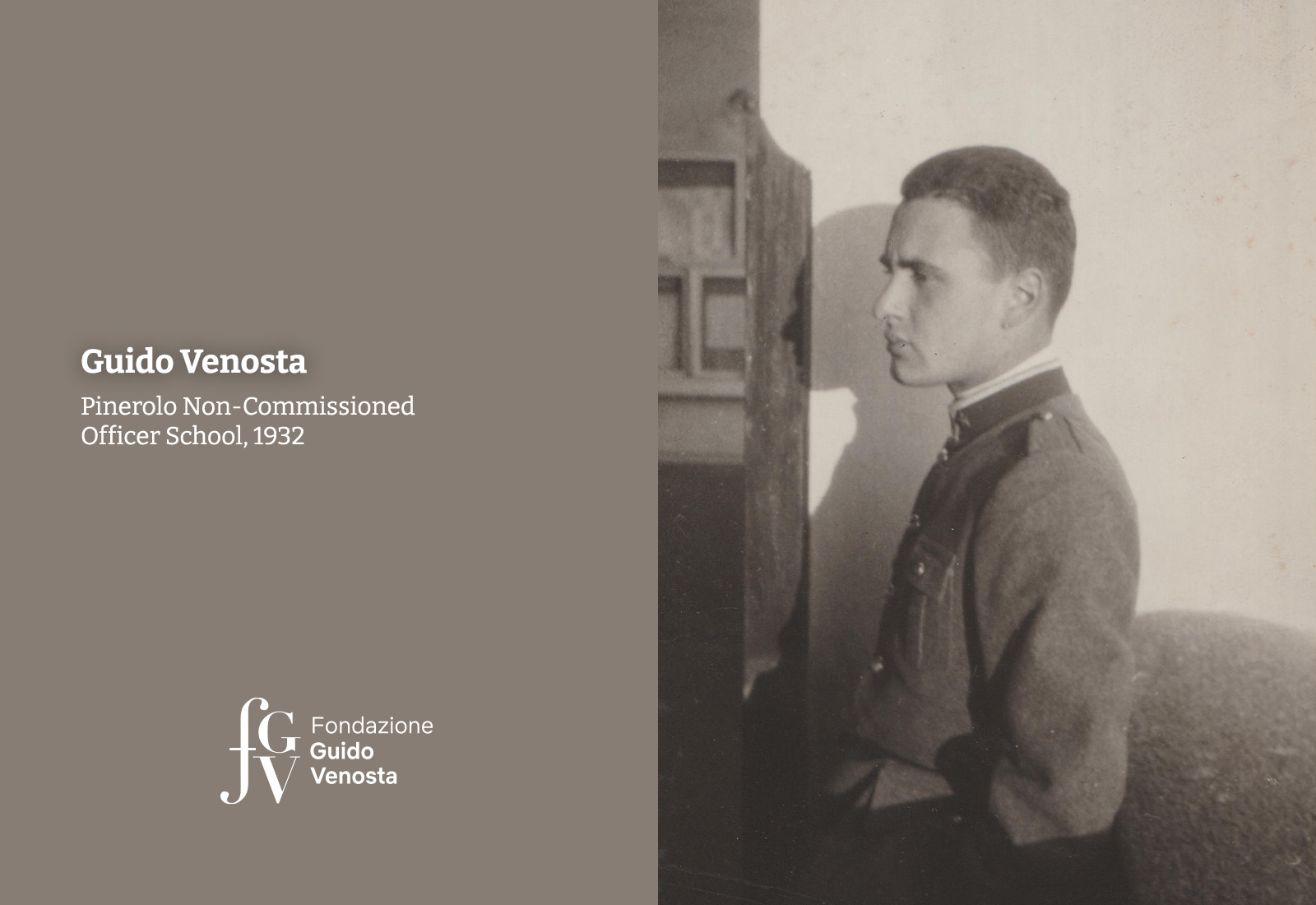
Then came the time for military service. Considering the great difficulties in renewing my passport—which, without it, would have prevented me from continuing my studies in England—I chose not to postpone it. My father had some reservations about advising me on which branch to choose. He believed that, with a brother already enlisted in aviation, opting for an offensive arm would increase the overall risk for our family. However, the fact that the Savoia Cavalleria Regiment was stationed in Milan prevailed, and, above all, the fact that a friend of my mother had Piero Ubertis as her brother-in-law— a cavalry captain—helped steer my choice by almost promising me a future assignment in Savoia.
Incidentally, at that time, Adalberto di Savoia-Genova, Duke of Bergamo and cousin of the King of Italy, was the commander of that regiment. (…) After the fall of the monarchy, he spent his final years in poverty. (…) Among us, his former officers, he accepted only a pair of twin pins for one of his birthdays, bearing the regimental insignia. [Guido Venosta remained deeply attached to the memory of the duke and always kept his photograph—with a dedication—in a beautiful silver frame, editor’s note]. (…) Naturally, one had first to attend the Pinerolo school and then pass the exams at the end of nine months of service as officer cadets. (…)
This, too, was a completely new experience for me. The discipline was strict, but not excessively so. What was required was that things be done well and fairly quickly. (…) I chose to be part of a very small group, whose members remain my friends to this day [1996-1997, editor’s note]. There were Paolo Corinaldi—later lost in Russia—Paolo Villa, Giangiacomo di Thiene (whom I later saw serving as an embassy secretary in London), Gianvico Borromeo—who later became ambassador to Libya—and finally Ruggero Di Bagno. (…) After completing the nine months of school and passing the exams amid all the expected fears, each of us set out to secure, if possible, an assignment of our own choosing. As mentioned earlier, I was assigned to the Terzo Savoia [Savoia Cavalleria Regiment, editor’s note], and it was there that my experience in a cavalry regiment truly began.
I have always remained closely linked to my regiment; as soon as I graduated, I joined the National Union of Discharged Officers of Italy, later becoming a member of the Savoia Cavalleria Officers’ Circle and the National Cavalry Association. I also wrote many letters to officers and commanders—both to congratulate them and to recall memories, and in the later part of my life, to stimulate their interest in “my” association, AIRC, the National Association for Cancer Research.”
Guido restò sempre legato al suo reggimento; appena diplomato entrò a far parte dell’Unione nazionale ufficiali in congedo d’Italia, poi fece parte del Circolo ufficiali Savoia Cavalleria e dell’Associazione nazionale arma di cavalleria, e molte sono le lettere che scriveva a ufficiali e comandanti, sia per congratularsi e rinvendire un ricordo sia, nella seconda parte della sua vita, per stimolarne l’interesse verso la “sua” associazione, l’AIRC, Associazione nazionale per la ricerca sul cancro.
Sources:
Albiate, Villa San Valerio Archives, Guido Venosta Archive, G. VENOSTA, Unpublished Memoirs (1996-97), pp. 20–24A.