
For decades, biodiversity was confined to the sphere of environmental debate, largely disconnected from issues of public health and human well-being. Scientific evidence from recent years has overturned this separation: human health is structurally dependent on the biological complexity of ecosystems. When biodiversity declines, health, social and economic vulnerabilities intensify, as documented by the World Health Organization (WHO) and the Intergovernmental Science-Policy Platform on Biodiversity and Ecosystem Services (IPBES).
This is not an ideological statement, but a structural fact: the quality of air, water and food, climate stability, and even the processes that regulate the human immune system are deeply influenced by the biological variety of the ecosystems in which we live. The IPBES Nexus Assessment 2024 maps with precision the interdependence between biodiversity loss, food systems, water resources, human health and climate dynamics.
Forests, wetlands, biologically active soils and balanced marine systems perform essential functions for collective health. They filter pollutants, regulate temperatures, reduce exposure to extreme events and limit the spread of pathogens. When these systems are simplified or degraded, they lose their protective capacity, increasing populations’ exposure to environmental and health risks, as also highlighted by studies published in The Lancet Planetary Health.
The One Health paradigm, now adopted by international organizations such as the WHO and the FAO, starts precisely from this awareness: human, animal and environmental health are interdependent and cannot be addressed separately.
Agricultural simplification and nutritional impoverishment: a silent emergency
The connection between biodiversity and health emerges with particular clarity in the analysis of food systems. Public debate tends to focus on the quantitative availability of food, while marginalizing a crucial issue: the biological quality of what we eat.
Over the past fifty years, agricultural systems have moved towards increasing simplification: fewer cultivated species, a reduced number of genetic varieties and highly standardized supply chains. This model has increased productivity, but it has also progressively impoverished the nutritional diversity of food.
Today, a significant share of the global diet depends on an extremely limited number of crops. The FAO report The State of the World’s Biodiversity for Food and Agriculture clearly highlights this: of the approximately 6,000 cultivated plant species historically used for food, fewer than 200 now make a significant contribution to global production, and only nine crops account for more than 60% of the world’s food production. Wheat, rice and maize alone provide around 50% of plant-derived global calories. Potato, soybean, oil palm, sugar cane, sugar beet and cassava complete the picture of the strong concentration of production within food systems.
According to the FAO, this concentration affects the entire agri-food system, including not only crops intended for direct human consumption, but also those used for animal feed and other industrial purposes.
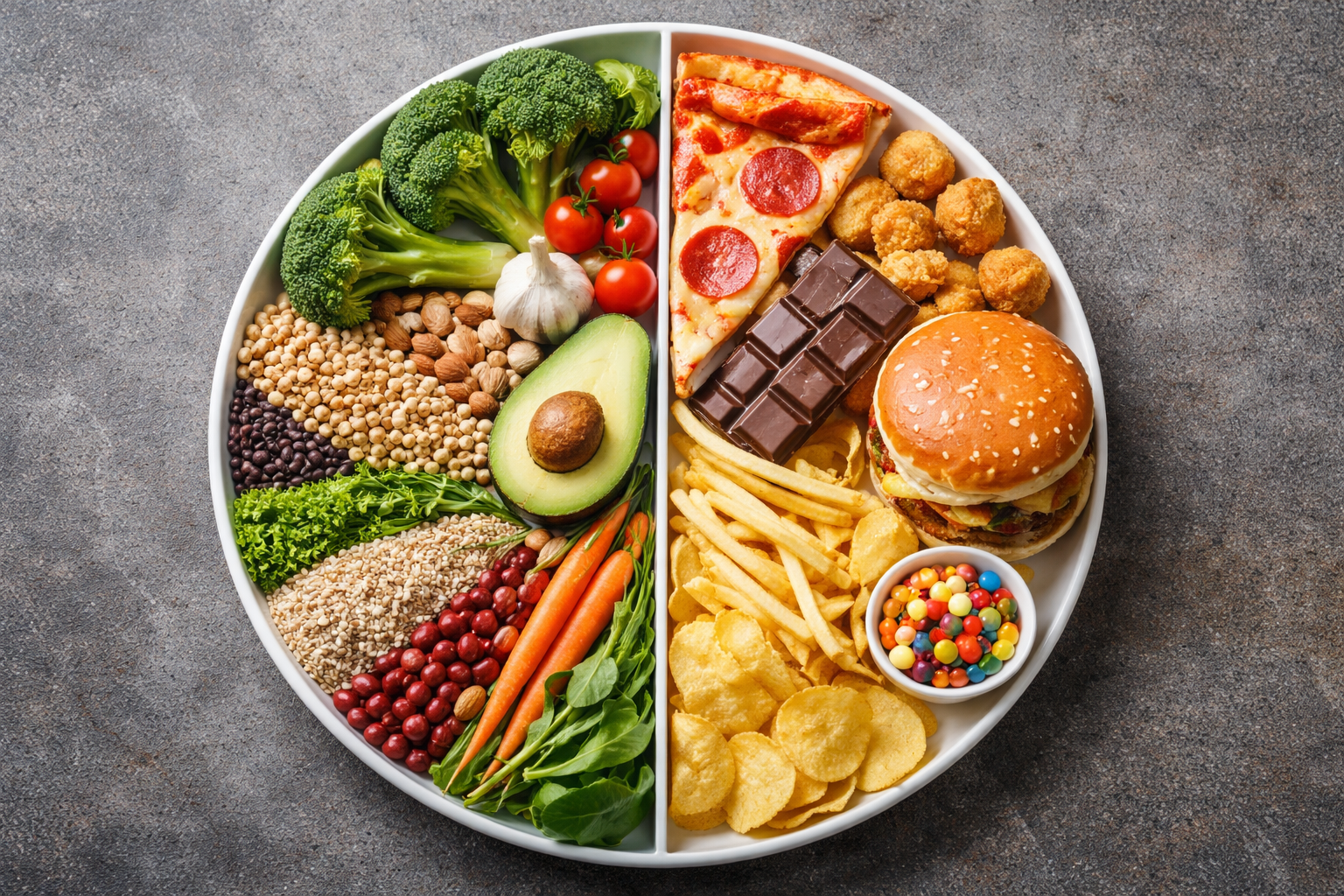
The result is a form of malnutrition different from the one historically associated with food scarcity: diets rich in calories but poor in micronutrients and fibre, associated with an increase in chronic diseases. According to the WHO, obesity is now the most widespread form of malnutrition in many parts of the world, including high-income countries. This overlap shows that adequate calorie intake does not in itself guarantee real nutritional quality, nor adequate health protection.
The rise of ultra-processed foods in low- and middle-income countries
Nutritional impoverishment is intensified by a second mechanism: the spread of ultra-processed foods (UPFs), especially in low- and middle-income countries. This phenomenon, documented by a growing body of epidemiological literature, accelerates the nutrition transition. Instead of gradually evolving towards more varied and balanced diets, many urban areas are rapidly shifting towards a model dominated by ready-made, standardized, energy-dense industrial products.
UPFs, formulated with refined ingredients, additives, flavourings and stabilizers, are gaining ground at the expense of traditional food systems in Latin America, Africa and Asia. The push is systematic: aggressive marketing, widespread distribution, competitive prices compared with fresh foods, and positioning as symbols of modernity and status.
The data show that the share of calories derived from UPFs is already high in several Latin American countries, such as Mexico, Brazil and Chile, and is rising rapidly in urban areas of sub-Saharan Africa and South-East Asia. In high-income countries, this transformation is even more advanced: in the United States, ultra-processed foods account for around 55% of calories consumed, while in Europe, in countries such as Sweden, the share exceeds 40%, among the highest levels together with the United Kingdom. In Italy, by contrast, UPFs account for 23% of energy intake.
The combined effect is twofold: on the one hand, diets become “flattened” around standardized matrices that are often poor in micronutrients; on the other, local production systems and traditional varieties — cereals, legumes, tubers and vegetables — are weakened along the supply chains. The result is an increasingly measurable paradox: diseases linked to excess, such as obesity, type 2 diabetes and hypertension, rise alongside forms of hidden malnutrition, with deficiencies in essential nutrients such as iron, zinc, vitamin A and folates.
Regulatory responses: the British case and the childhood obesity emergency
In response to epidemiological evidence, some governments are adopting restrictive measures on the marketing of ultra-processed foods. From 5 January 2026, the United Kingdom introduced regulatory restrictions on the advertising of foods classified as HFSS — High in Fat, Sugar and Salt — according to the Department of Health’s Nutrient Profiling Model, limiting their promotion on television before 9 p.m. and banning online advertising.
The restrictions apply to products including biscuits, processed cereals, soft drinks, frozen products, pizzas, ice cream, confectionery, flavoured yogurts, certain fruit juices, sweetened breakfast cereals, baked goods, energy drinks, milkshakes, burgers and frozen chicken nuggets. Nutritionally adequate versions of the same products, such as natural yogurts and unsweetened wholegrain cereals, are excluded from the restrictions.
The measure responds to critical data collected by the National Health Service (NHS) through the National Child Measurement Programme (NCMP): 22% of children in England are obese or overweight when they enter primary school, at around five years of age, a figure that rises to 35.8% by the time they leave, at ages 10–11. Tooth decay, a direct consequence of the consumption of added sugars, is the leading cause of hospitalization among children aged 5 to 9 in the country.
The government estimates that the measure could prevent 20,000 cases of childhood obesity each year and encourage manufacturers to reformulate products towards improved nutritional profiles. This is an explicit recognition that individual food choices are shaped by the informational and commercial environment, which requires regulation in order to protect public health, especially among vulnerable populations.
In Italy, the framework is different: at present, there is no restriction equivalent to the British one on the advertising of HFSS products. However, the data indicate that excess weight during childhood and adolescence remains a significant issue. Commenting on a recent report, Nicola Graziano, President of UNICEF Italy, highlighted that among children and adolescents aged 5 to 19, the share of those overweight fell from 32% in 2000 to 27% in 2022, while obesity remained stable at 10% in 2022 and thinness increased from 1% to 2% over the same period. In this context, the debate on how to reduce children’s exposure to the promotion of foods high in sugar, salt and fat — and on which regulatory tools should be adopted — is set to grow.
Also read: According to a new report released by the UN agency, this year one child or adolescent in ten worldwide is overweight, and since 2000 obesity has increased, rising from 3% to 9.4%.
The decline of local varieties as a risk factor for global health
Agricultural biodiversity is not only about how many species we cultivate, but also about how much variety exists within each species. When local varieties disappear, we lose part of the richness of food and end up eating in an increasingly uniform and standardized way.
It would be incorrect to place all responsibility on individual choices. What we find on supermarket shelves depends above all on decisions made upstream: how we produce, how supply chains are organized, which standards are imposed by industry, and how food is distributed and promoted. This is why food biodiversity is a public health issue, not merely a matter of personal preference.
Restoring the link between biodiversity, food systems and health means shifting attention from the treatment of chronic diseases to prevention: protecting and rebuilding the biological diversity that makes the system more resilient. This requires coherent policies: more diversified agriculture, protection of local varieties, and renewed value placed on traditional diets and food cultures.