
Educating does not mean teaching, but enabling
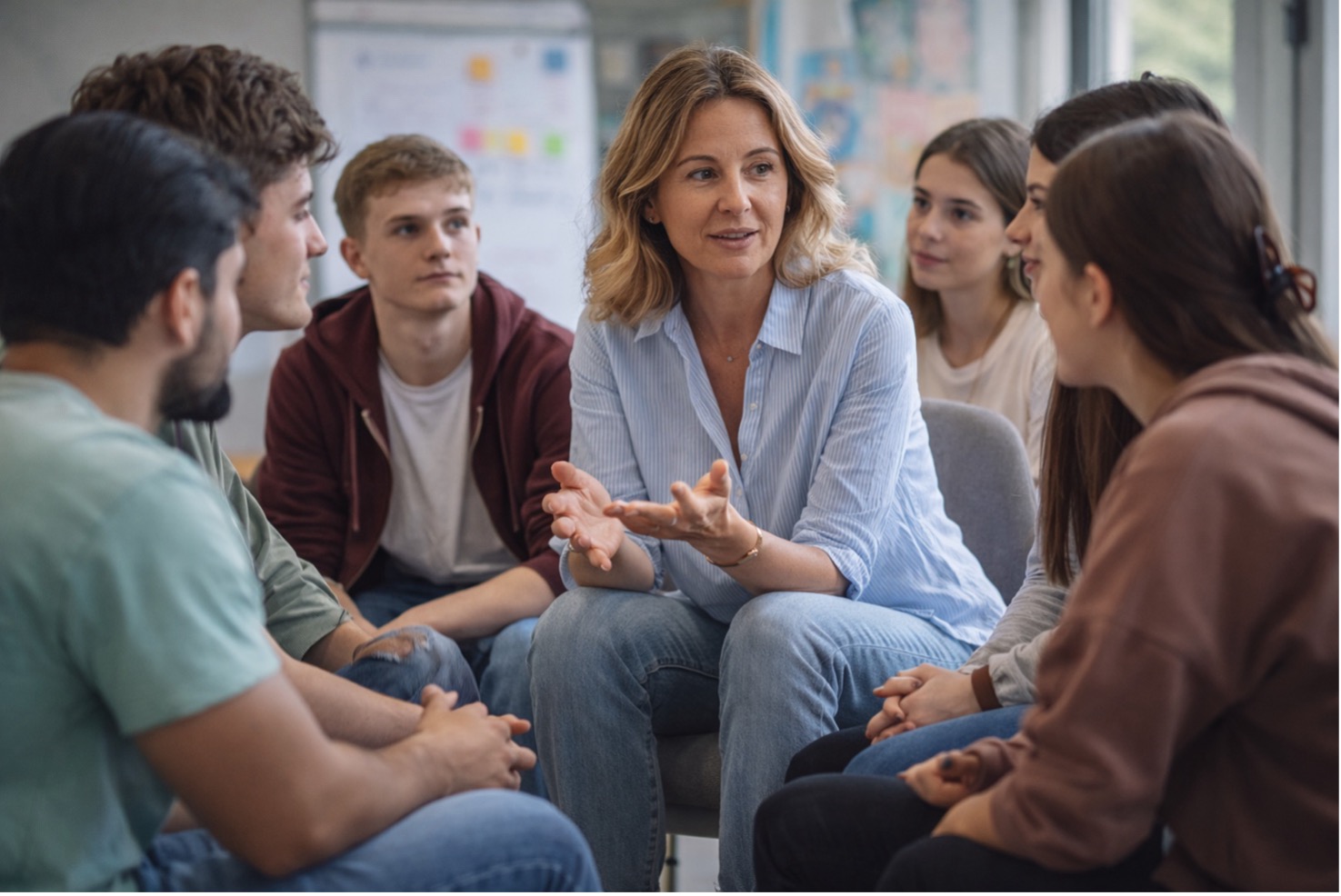
In an increasingly complex and unstable world, education can no longer mean simply transmitting knowledge.
“Educating means helping young people become capable of being in the world,” says Dr Alessia Lanzi, psychologist and psychotherapist at Minotauro. A perspective that places not only knowing, but also being and doing at the centre — the capabilities needed to navigate the present.
This vision takes shape in the project “Happy. diventare capaci”, supported by Fondazione Guido Venosta and active in Milan, Seregno and Sovico, in collaboration with Minotauro, Spazio Aperto Servizi and CSV Monza-Lecco-Sondrio. The programme involves over 400 adolescents, 60 parents, 50 teachers and 30 local organisations through experiential workshops, after-school activities, counselling services and training pathways for the educational community.
Within this framework, Dr Lanzi, project lead, guides us through a reflection on what it means to educate today.
When we say that educating means enabling, what capabilities are we referring to today?
We are talking about the ability to face a complex world: to navigate change, tolerate uncertainty, cope with effort and build one’s own path. Today, educating means helping young people develop emotional, relational and inner resources to orient themselves in reality.
In a world increasingly mediated by technology, does educating for capability take on a different meaning?
Yes, profoundly. Technology is no longer just a tool; it has become an environment. Young people and adults inhabit both the physical and the virtual world simultaneously, and this inevitably reshapes the educational task.
The digital world offers clear opportunities — connection, access, learning, relationships — but also brings concrete risks: overexposure, weakened bonds and the substitution of the real with the virtual.
For this reason, rather than multiplying rules and prohibitions, education should help young people question the meaning of their actions, recognise what they feel and develop greater awareness of how they inhabit these spaces.
Educating for capability also means tolerating frustration and uncertainty. Are we truly able to support this process?
This is a fundamental challenge. There is no learning without frustration. Learning means confronting not knowing, effort and the time required for something to truly take shape.
Yet today, as adults and as an educational system, we often do the opposite: we anticipate, protect, intervene too early and try to remove obstacles immediately. In doing so, we deprive young people of the very space where they could learn to cope with difficulty.
Effort is often interpreted as a sign of inadequacy, rather than as a natural part of growth. When this happens, the risk is paralysis: people stop, withdraw and disengage from the learning experience itself.
What role does error play in an educational path oriented towards capability?
Error is a fundamental step. If education aims to make people capable, error should not be feared or demonised, but integrated as a learning tool.
Allowing young people to make mistakes — and, above all, helping them reflect on those mistakes — is what builds true competence and resilience.
Adults, however, must ask themselves whether they are truly ready to give young people the time to fail and then develop new capabilities.
Is there a simple, everyday gesture that truly helps a young person become more capable?
Asking more questions and offering fewer immediate solutions.
This does not mean leaving adolescents alone, but rather avoiding the urge to fill every gap with an instant answer. Being present in the relationship, listening, naming what is happening, tolerating not understanding everything right away — it is in this space that young people begin to build identity, autonomy and personal resources.
Many abilities we take for granted — organising oneself, relating to others, managing the unexpected, dealing with discomfort — do not develop automatically. They are learned over time, within a patient, concrete form of guidance that is present without replacing.
Today, educating does not mean filling or mechanically correcting. It means creating the conditions for a young person to become progressively more competent in their relationship with themselves, with others and with the complexity of their time.
In other words, educating means enabling someone to inhabit the world.
Looking ahead
Rethinking education in terms of capability means looking beyond the present and committing today to building, together, a community able to support young people not only in moments of success, but above all in times of difficulty and in the face of mistakes.
What is needed are not predefined answers, but relational, emotional and inner compasses to help them navigate their time — and the willingness to remain alongside them in uncertainty, without filling every silence, without anticipating every struggle.
This is where capability begins.